object of memory

we must return to where it was lost / if we want to find it again

Category: all things grow

  • body narrative

    body narrative

    Much to my loving husband’s chagrin, I adore tattoos. I have several and the collection has grown in recent years. With age I have found a deeper connection with my body, my skin. In spaces where I once wished to obscure my stories, I now find beauty in the reveal. I enjoy the feeling of the art being tattooed. There is something about the needle work that calms and serves as markers of time, moments, and meaning.

    The relationship between my body and me is complex at best. The empowerment derived from having a history I control written upon it is more meaningful than I ever imagined.

    (more…)
  • a test of little things

    a test of little things

    Despite teaching for almost ten years, I’m not certified. I have a BA in education and child study and have a long, long list of professional development courses under my belt, but after a while that starts to feel useless without the actual certification paperwork and licensing to back it up. It has taken me a considerable amount of time to discern my place in the realm of teaching and learning. I don’t neatly fit into prescribed curricula and predefined boxes, but I understand that to deconstruct and reinvent systems, I must first immerse myself within them.

    I signed up for my Early Childhood Praxis exam this morning. I’d been putting it off for, well, years, but the time has come and I just need to suck it up and take a standardized test, despite my loathing of such evaluative modalities. I gave myself a short lead time to the at-home test, as I know myself, and while my concentration on anything has been minimal as of late, I know condensing the amount of time is most beneficial for my learning style. I just need to take the fucker and get on with things.

    In other news, Sid will be returning home for his first visit since he left in June, a prospect that fills me with joy. He’s been thriving at his new school, and I’m hopeful that he’ll be back for good by late spring. I’ve refrained from dwelling too much on the specifics of his visit, focusing instead on maintaining the rhythm of his current life, which has been crucial for his growth. Our phone conversations reveal a young person maturing, displaying more rational and well-defined reasoning. It’s hard to determine whether this transformation is a natural progression of adolescence or a result of the extensive support he’s received over the past five months. It’s probably a harmonious blend of both. Every time we hang up the phone, I can’t help but smile, even if the conversation has been difficult. I miss him dearly but am also eager to witness the person he’s becoming.

    Becoming has been a big theme in the last half of this year. I feel very much that each of us is on the cusp of something. After months of floating in chaos, our pieces are landing, slowly, and it’s like a new collage taking shape. While I’m not a fan of uncertainty, I’ve learned that living in the moment often requires embracing some ambiguity, exercising patience, trusting oneself and those around us, and finding a balance between what we can control and plan for, and those elements that demand time and flexibility.

    A gentleness, I think.

  • i feel numb, burn with a weak heart

    i feel numb, burn with a weak heart

    My family has a Labor Day tradition – a trip to the shore without me, because to be blunt, while I love beaches, I am not a fan of sitting on them in the blaring sun. I am more of a rocky, cold, rough water, and sparsely populated beach person, which is the exact opposite of the Jersey Shore. Tradition dictates that I remain in our home with the dog, three cats, and a very antisocial and possibly blind lizard. I don cruddy clothing and pajamas and chip away at the layers of our house that come from living with three humans who cannot part with anything. In short, they leave, and I donate things and throw a lot away. It is my favorite weekend of the year.

    This is why I am sitting in the dark at my kitchen table, the moon’s glow filtering through the skylight, apologizing to a parent whom I just spammed with things to think about for the school year, not realizing it is past midnight. I have five browser windows, three documents, and four email accounts open on my screen. I am bouncing between discussions with schools, lawyers, clinicians, my own teaching/caseload, a course presentation that is due soon, a creative writing piece that I can’t seem to push out words for, and a pleasure project that I am slowly hedging through that involves rewriting Sol LeWitt’s sentences on conceptual art for preschool (because OMG, it works. It. Works.). I’ve only been able to sit still to work on the above because of the satisfaction gained from organizing the garage and both kids’ rooms and 85% fixing the rusted ball joint on our basement bathroom sink stopper.

    That was a very long way of explaining how one person in this giant world regulates herself during a period of deep sadness. I write this not because all is doom and gloom because it’s not, but because sometimes we need to acknowledge the strange mass of Vantablack in the room. In my case, that’s grief.

    I tackled one of the messier spaces in our house a few hours ago – a small sunroom that holds an exercise bike, a few weights, and our PC and printer. It was filled with piles of crap – both kids’ unemptied backpacks from last year, random pieces of paper, baseball and Pokémon cards, Sid’s art supplies, and all of the phone chargers I have been looking for over the last twelve months. I emptied Emmett’s pack first, then scooped the playing cards into a box to be sorted. I pulled out unused supplies that could be used this year and paused for a second to sigh and lament that my baby is now in his last year of elementary school. Then, it was time to go through Sid’s things.

    Sid has been away for seven weeks, and we are preparing for his next step, which likely will not be at home with us. I cannot express how difficult this has been for the entire family, and each time we get over one hump, another higher hill of emotion awaits. I am incredibly proud of my child and of all four of us. Healing – understanding and learning from how each of us communicates, tackling and sitting with excruciating feelings, navigating the should have / could have / wish we had threads of guilt – is really fucking hard work.

    I had spent the morning on calls and email back and forths about my child’s future, and then took my seething anger at the American school and mental health systems and channeled it into cleaning out the refrigerator. When I finally went through Sid’s backpack, I was blasting music on the turntable because I needed to feel it reverberate through my everything. Plus, it can’t hurt to dance a little.

    So, I was dancing on the gross carpet after chucking half-completed homework assignments and old candy wrappers into the garbage when I realized I was hugging Sid’s backpack. I had pulled the canvas close to my chest, my fingers rubbing the material, and the lyrics Home is where I want to be / Pick me up and turn me round /I feel numb, burn with a weak heart / I guess I must be having fun ran through my brain like razors of emotion. I curled around the backpack, kneeling on the half-cleaned floor, and sobbed. I cried hard and then hung his things in the hall closet and stood in the clean, empty living room and listened to the needle tracking on the record’s dead wax, the crackle of no sound, and thought to myself, did I just hurt so hard that I feel nothing, or did I open wide until the emotions completely filled me?

    I’ve been thinking a lot about that irony of emptiness. A room can appear so full but actually be vacant; conversely, an empty space can be so full of memory. In these days of intensity, these moments that trigger the need to cleanse and organize and reorganize and seek sense and order, the fullness feels so empty, and the emptiness so full.

  • all things grow, all things grow

    all things grow, all things grow

    The New York Times recently published an article about the Folly Tree Arboretum. It was in the Styles section, which I found quite odd, but I guess Folly Tree is on the Eastern Fork of Long Island, so it qualifies as stylish. Regardless, the arboretum combines three giant pieces of my heart – narrative, memory, and nature. You can read about it here.

    My brain always trends toward the vernacular. History is awesome, and momentous events deserve mention, but my passion sits in the magic of everyday memories – the experiences that you or I have individually or collectively, interactions and exchanges that someone else might find mundane or irrelevant, but when looked at within the context of the personal or collective landscape, have meaning.

    I studied the history of New York City architecture in grad school. While I deeply appreciated historic preservation, I consistently found myself drawn to the stories within the walls. Who lived there? What was their life and community like? What were their narratives? More often than not, I was interested in vernacular architecture – buildings that might otherwise be overlooked by preservationists (though this has changed somewhat) but held sociocultural meaning when looked at against the landscape of time.

    It’s been a long, long time since I’ve had the quiet space to navel gaze, and recently, I’ve dipped my toe back into the activity in an attempt to remember and revivify who I was five years ago, before the pandemic, before all of this family upheaval. As I explained to a friend recently, I’m not entirely sure what makes me happy anymore. Reading about Folly Tree reminded me of those tiny sparks within. Narrative keeps my soul afloat, and if you peek into my home, you will find myriad objects that I have kept – my objects of memory – that tell the stories of my life.

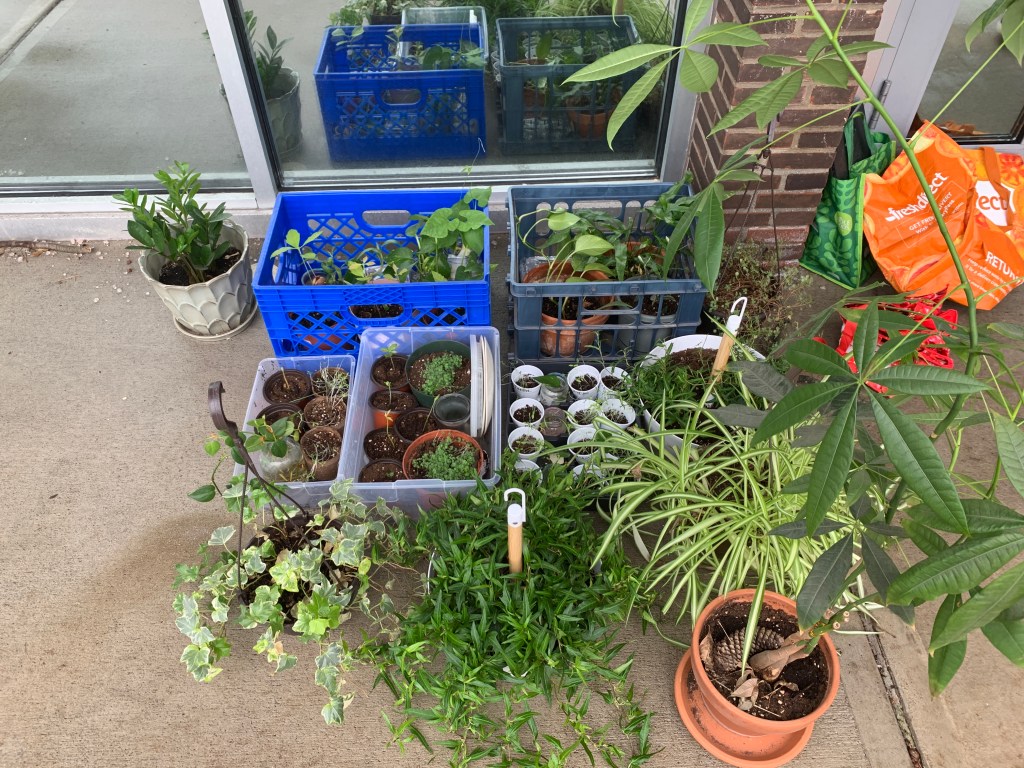
    Oak trees produce acorns in cycles. There was a bumper crop in the fall of 2019, and in early 2020, they emerged from their wintering. One of my favorite things to do with preschoolers is plant seeds, and when I noticed several acorns near my house beginning to germinate in decomposing leaves, I brought them to my 3s classroom. Each child planted an acorn and then asked for more. We spent a good chunk of January and February exploring seeds from their foods at home – apple, lemon, avocado, etc. In early March, one child brought in dragon fruit seeds, and we curiously planted the tiny specs in peat pots and put them in the window.

    In mid-March, the world shut down. On Friday the 13th, I packed the kids’ plants into my car and took them home from school. We were told “two weeks,” but I knew it would be longer, so I arrived home with a greenhouse of seedlings and placed them all over the kitchen. We all know where this story goes. We didn’t go back. I taught through the entire pandemic, albeit outside; most kids in our town didn’t set foot into a normal classroom for a year and a half.

    I now know that my reaction to the pandemic was outsized – it fused together a bunch of baggage that has taken several years for me to identify and begin to disentangle – but my initial urge, or perhaps agony, was that I wanted to keep every child safe. I couldn’t do that, nor was it my job to do so, so when I wasn’t riding my bike to kids’ houses and trying to keep them company on their sidewalks, I was taking care of oak and dragon fruit sprouts. And they grew. They grew and grew and grew.

    Not all of them survived. When we returned to school somewhat normally but “with an abundance of caution” in 2021-22, one oak tree and two dragon fruit plants remained. I taught kindergarten that year, and one of the students from my pandemic 3s class attended. When I saw her, now almost six years old, my heart burst into a million pieces, as her oak tree was the one that had survived.

    I carried the sapling back to my school with a shovel and trowel that fall. During one of our outdoor play periods, that child and I dug a deep hole in the wooded area where the kids ran about, and we planted her tree. It looked like all other trees around it – a spindly baby oak, its leaves dropping – and no one would have known its importance. But I did. It was the acorn that survived. It was grief and helplessness and passion and hope. It was a moment passed and a living memory. And a future that continues to grow.

    The beautiful thing about memory is that it’s always vernacular. What one holds as precious, another may never fully understand. But our memories can be like forests. We all have our oak trees – the tiny acorns that woke in their beds of decomposing leaves, growing within our experience’s conditions and standing tall together. Our stories are all different but they make up the collective, and in that, there is so much power.

    [Note: The dragon fruit plants still live in my kitchen!]