A student runs toward me as I carry a bowl of lettuce, peppers, and baby carrots to the rabbit hutch. “I want to help!” he yells, zooming to my side. He is four and in the early care program, and I know him because he loves animals just as much as I do. I let him make two small bowls of salad for the rabbits.
I lift the top of the hutch to remove the old food cups, and beneath one is the lifeless body of a newborn bunny. Instinctually, I cover the tiny corpse, bend to accept the child’s salad, and call out to the early care children that they are taking a surprise trip to the playground.
When the room is quiet, I lift the kit carefully with a towel and hold it in my hand. It is still pink. Its eyes are closed. It is all at once life and death. It is impossible to know where one stopped and the other began. The world is airless for a moment. I feel nothing, and then deep sadness that burns through my chest.
I grew up with a giant patch of wild raspberries. I would duck beneath a bow of leaves and thorns, and my backyard would disappear. Instantly I was transported into a forest of rubies. They hung heavy from the branches, and the brambles were so dense that birds could not penetrate the understory. I remember many mornings sitting on the ground, filling my mouth with the tart and sweet magic, getting mauled by mosquitoes but not caring, as the berries were just once a summer and sometimes in early fall, and their taste was unrivaled.
I left the house this afternoon for the first time in several days. Life has been like that lately – I turn around and am unsure of where I am in time. I’ve been hiding a bit, hesitant, and aware that my head feels thick and slow and that it’s been a challenge to keep up with conversations. We have been in survival mode for over a year. Now that some of the restraints have been lifted, it’s been hard to know what to do, think, and how to feel.
A raspberry patch is in a school garden across the street from my house. I began caring for it during the pandemic. It was overgrown with trees and weeds, and I spent hours working the soil and protecting seedlings from hungry birds and squirrels. Someone had planted raspberry canes. I trimmed them dutifully for three years, confining them to one raised bed.
I couldn’t bring myself to grow or care for anything this year. Spring came and went, and I did not turn the soil in my backyard for peas and tomatoes. I didn’t touch the school garden. I couldn’t deal with the idea of having to help something survive, probably because every fiber of my being was dedicated to ensuring that my oldest child remained on this earth. My survival, in so many ways, depended on his.
My oldest loved raspberries since the moment he began eating solid foods. He is the first one by my side when we gather blackberries in Vermont or strawberries at a local farm. The past few summers, I’ve gone out early to pick the school raspberries, then left a bowl for him on the kitchen counter. Even at eleven and twelve years old, he’d put the berries on his fingertips to eat them, and each time he went through the process, my heart would melt. Every so often, I’d have a dream where he and I were crouched beneath the brambles collecting the red fruits in our cupped hands, his blond curls glinting in the filtered sunlight. I am used to him by my side each summer, picking those berries. But this summer, he’s not.
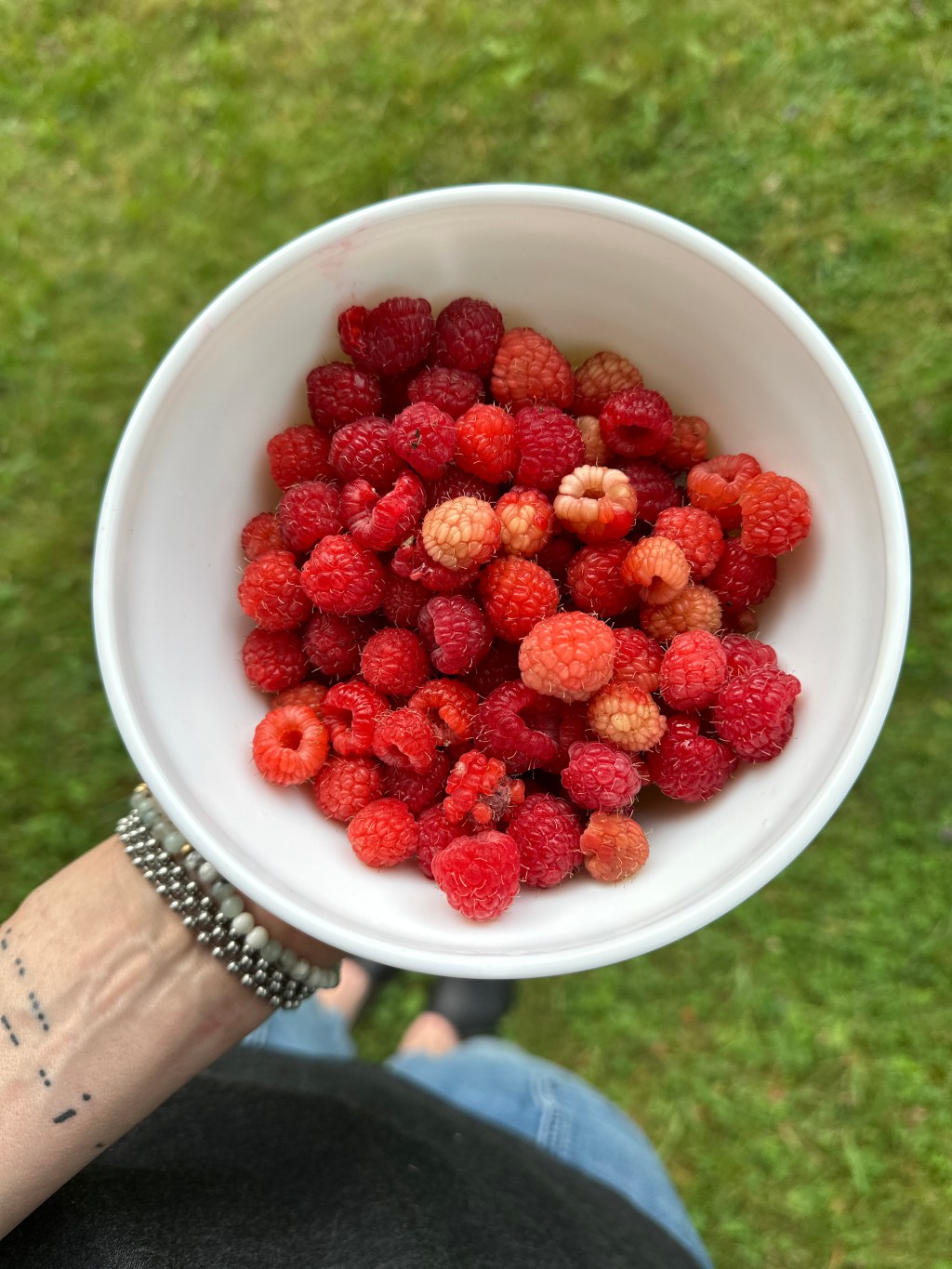
This afternoon I slipped on my clogs and shuffled over to the raspberry patch with a bowl in my hands. I started at the base of the thicket, picking, moving up to the top methodically. I stepped into the thorns, searching for the fruits hidden beneath. There’s an art to picking berries. You look at the color first, then gently wrap your fingers around the fruit. If it slides off the branch without effort, it’s ready. Any tugging and it’s not ripe enough.
As I picked, I thought about my son. I thought about how difficult it is as a parent to reconcile the concept that you cannot fix everything, that sometimes, despite all your efforts and love, you are not enough – and that not being enough is okay, even though it hurts like a million daggers tearing apart your heart. I thought about how much I miss him even though it’s only been three days. I heard his voice as a baby and his sounds as a teenager. I smelled his hair. I felt his warm hand in mine.
I put a perfect red raspberry in my mouth and let it melt. I felt the taste hit my senses, the tart at my cheeks, the sweetness beneath my tongue. My eyes teared as I imagined myself as a child beneath the brambles, then my son, our voices hushed, our fingers stained. I thought about how I’d encouraged him to visit the patch a week ago and that he’d declined, withdrawn and sad, ready to move on to whatever the future was, toward the uncertainty. I remembered how much my heart hurt when he said no to joining me, that sense of loss, not just for that moment but for all the struggles and heartaches of our recent past.
There’s a bowl of raspberries on my kitchen counter. I’d like to say that they are waiting for my oldest son, but I know that they are not. He is in California, and I am in New Jersey. He is receiving the help that I could not provide. He is not eating these raspberries, but I am. One by one, I put them in my mouth and close my eyes. I feel the taste spread like the beauty of memory sprawling throughout my consciousness. I take in the flavor and all of the wonder that flows from it and think of my child, and know that, at some point, it will be okay.
I am a forest person, but my richest memories have been formed on the shore. I grew up there, feet numbed to the rocky northern coastline, face salty, lungs stiff from seawater, hair bleached white from the sun. As a child, my mother shared stories of her youth – summers spent on a similar slice of shore, away from the city heat, in the 1950s when eastern Long Island was just on the verge of development. I would trace my fingers across square black and white photographs as I listened, faded pictures of twin girls standing in the sand, the same tousled hair as I would have three decades later after long days watching the tide ebb and flow, after building sand tunnels and trapping jellyfish, after warm, gritty peanut butter sandwiches and sunburnt shoulders.
My aunt died of cancer at forty-nine. Before her battle ended, back when she was still in her apartment on West 84th, when I was still walking across town to help with groceries and late-night trips to the hospital, we took a walk. We hobbled past Zabar’s and Fairway, and then, tired, she asked to rest by the river. We sat together quietly at first, and then she talked about family. She spoke of dying. She told me that her greatest fear was being forgotten.
My father called the morning before her death to tell me it was time. By then, she had moved in with them, her hospital bed in our den, and later, in hospice. I remember the train ride east from Penn Station, the rush of the city disappearing, swallowed by suburbs, the blur of fall foliage.
After her last breath, after our goodbyes and the grieving and relief, once the night wrapped around us, I climbed into my mother’s car and drove down to the shore in the darkest of darkness. At the turnoff from North Country, I shut off the headlights, moving fast and blindly, steering only by the feel of the curves. I knew them by heart. It was like driving with my eyes closed, except they were open and encased with heartache.
At the beach, I climbed a lifeguard chair. It was a clear night, cold. The waves crashed, barely visible in the darkness. I could see Connecticut shimmering just beyond the horizon, a razor-thin line of light defining water from the sky. I sat on the giant wooden chair and cried harder than I thought possible. I cried until I gagged and gasped for air, until my lungs and ribs felt bruised, until my head ached. Once empty, I took a running jump off the chair, spread my arms wide, and felt that brief moment when time was suspended, the millisecond before my body tumbled downward, slow then fast, to the damp sand below.
Years later, my mother told me she’d driven her sister to the beach days before she died. My aunt had longed to see the beach but was too weak to leave the car. They sat in the parking lot, watching the gentle surf. Twins returning to the shoreline.
Eventually, my parents sold the house and moved north. I didn’t return to my childhood beach until almost a decade later when I was heavily pregnant with my first child. We had set out east to go apple picking, to buy a pie at a stand that I’d remembered as a little kid, but en route, I longed to get off the ugliness of the main roads, and we detoured to the sound. The beach was the same as when I was six and sixteen and twenty-one, empty in the late September sun, the shore still beautifully rocky, the smell of salt and seaweed, the clam and mussel shells, the weathered sea glass.
The week before my first child was born, as my husband and I stood together on the shore of northern Long Island, I thought about the journey we were about to embark on, the unknowns, the possibilities, the fears. I imagined the joys and the heartbreaks and the ordinary moments in between. I thought about the strength of the moment on the cusp of motherhood. I thought about the fragility of life.
I dipped my toes into the cool sand and felt the humid breeze against my cheek. I placed my hand on my swollen belly and looked toward a lifeguard chair. I thought about that painful night and remembered the numbness of driving in complete darkness, hurtling through unbearable emotions, half wishing that the car would cut a curve too close, that it would careen out of control so that I just wouldn’t have to feel. I looked across the sound to the tiny speck of Connecticut glittering in the afternoon sun.
I envisioned my aunt. I imagined what she might have looked like as a child running down the shore of Wading River. I remembered her smile, steadying her bike with one hand as we talked, having run into one another on La Guardia Place. I conjured that moment on Riverside, her body weak, on the brink of her last journey.
I wish she could have known then that her memory is always with me, that for years I would walk by her apartment building and trace my finger across her last name on the buzzer, which remained there for years until the building was sold. I wish she could have known that when I ran my first NYC Marathon, I ran it for her, repeatedly saying her name in my mind as I crossed through each borough, that I smiled and burst into tears at the finish line, that I’d carried a small photocopy of her portrait folded in the pocket of my shorts.
I wish she could have known that my oldest child’s name is hers, that I knew that day, feet digging into the sand, heart filled with remembrances, that I could capture a tiny piece of her, of us, in a new and vibrant life to come. I can’t know for sure, but perhaps she knew, somewhere in there, that the rocky shore and sea salt air was a bond we carried together in our blood, in moments that, while not congruent, were unspoken, soft reminders, memories in the lapping waves.
On the first full day, we search for stones in the Ventura riverbed. Each of us unearths works of contemporary art – geometric wonders, inadvertent sculptures, rocks veined with intersections so perfectly haphazard that they could be purposeful. I collect more than my pockets can support. My backpack pulls at my sunburnt shoulders, laden with a makeshift museum of rocks.
My favorites are the broken surprises – the stones that appear whole, veins like scars. Lift them, and the pieces separate, some like puzzles, others like folded treasures.
What is the nature of brokenness? These stones, laced with fissures, nestled in the riverbed: are they fragile failures of stability or simply waiting in the silt and sun, welcoming the rush of river water from fresh rain, settling into the inevitable, the process of becoming?
Let me tell you the story of whole versus broken, the infinite possibilities of piecing together. Let’s weigh the gravity of words and assumptions and ask, when the rains come, and our comfort is dislodged, do our pieces form newness, do they round and weather with the tumult? Do our sharp edges blur?
Our unit of four hikes our way back to the car. The landscape is sage mottled with yellows and pale purples. Our pockets are heavy with moments.
A year has passed, and I still cannot touch our museum of stones. They sit in small bowls on shelf in my office closet, too beautiful to part with but too painful to relive. How could we have known that so much had already broken, that we sat together like those pieces of the whole but already shifting? That the river was already rushing. The water just hadn’t hit us yet.


 object of memory