object of memory

we must return to where it was lost / if we want to find it again

Category: journeys

  • all things grow, all things grow

    all things grow, all things grow

    The New York Times recently published an article about the Folly Tree Arboretum. It was in the Styles section, which I found quite odd, but I guess Folly Tree is on the Eastern Fork of Long Island, so it qualifies as stylish. Regardless, the arboretum combines three giant pieces of my heart – narrative, memory, and nature. You can read about it here.

    My brain always trends toward the vernacular. History is awesome, and momentous events deserve mention, but my passion sits in the magic of everyday memories – the experiences that you or I have individually or collectively, interactions and exchanges that someone else might find mundane or irrelevant, but when looked at within the context of the personal or collective landscape, have meaning.

    I studied the history of New York City architecture in grad school. While I deeply appreciated historic preservation, I consistently found myself drawn to the stories within the walls. Who lived there? What was their life and community like? What were their narratives? More often than not, I was interested in vernacular architecture – buildings that might otherwise be overlooked by preservationists (though this has changed somewhat) but held sociocultural meaning when looked at against the landscape of time.

    It’s been a long, long time since I’ve had the quiet space to navel gaze, and recently, I’ve dipped my toe back into the activity in an attempt to remember and revivify who I was five years ago, before the pandemic, before all of this family upheaval. As I explained to a friend recently, I’m not entirely sure what makes me happy anymore. Reading about Folly Tree reminded me of those tiny sparks within. Narrative keeps my soul afloat, and if you peek into my home, you will find myriad objects that I have kept – my objects of memory – that tell the stories of my life.

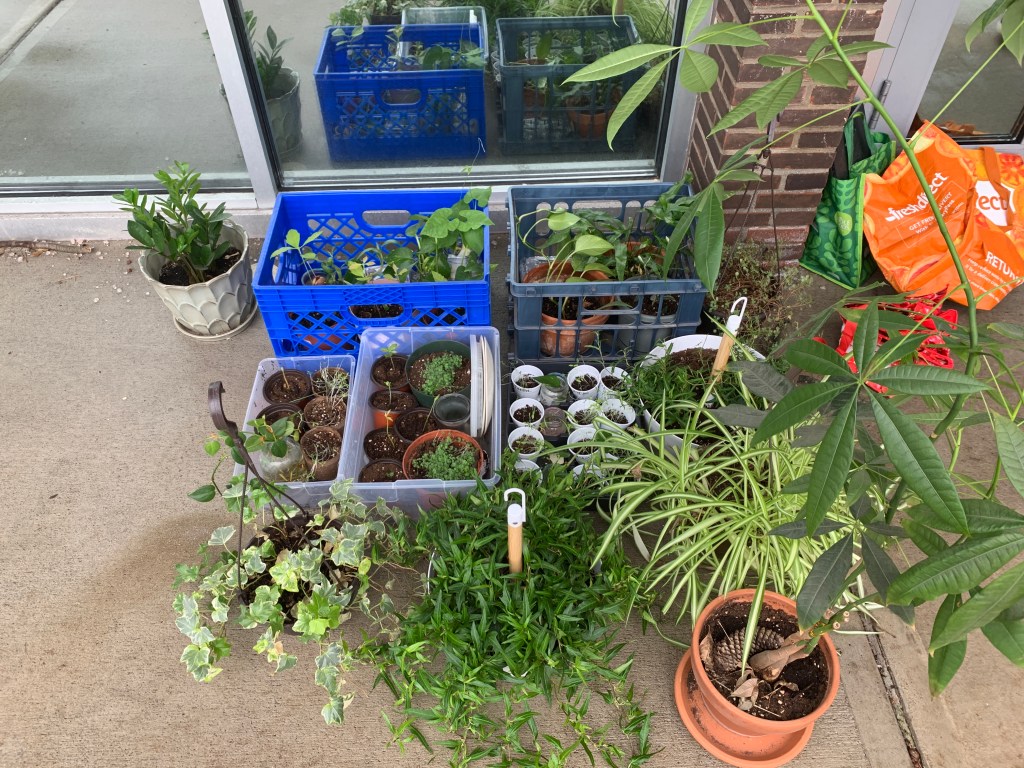
    Oak trees produce acorns in cycles. There was a bumper crop in the fall of 2019, and in early 2020, they emerged from their wintering. One of my favorite things to do with preschoolers is plant seeds, and when I noticed several acorns near my house beginning to germinate in decomposing leaves, I brought them to my 3s classroom. Each child planted an acorn and then asked for more. We spent a good chunk of January and February exploring seeds from their foods at home – apple, lemon, avocado, etc. In early March, one child brought in dragon fruit seeds, and we curiously planted the tiny specs in peat pots and put them in the window.

    In mid-March, the world shut down. On Friday the 13th, I packed the kids’ plants into my car and took them home from school. We were told “two weeks,” but I knew it would be longer, so I arrived home with a greenhouse of seedlings and placed them all over the kitchen. We all know where this story goes. We didn’t go back. I taught through the entire pandemic, albeit outside; most kids in our town didn’t set foot into a normal classroom for a year and a half.

    I now know that my reaction to the pandemic was outsized – it fused together a bunch of baggage that has taken several years for me to identify and begin to disentangle – but my initial urge, or perhaps agony, was that I wanted to keep every child safe. I couldn’t do that, nor was it my job to do so, so when I wasn’t riding my bike to kids’ houses and trying to keep them company on their sidewalks, I was taking care of oak and dragon fruit sprouts. And they grew. They grew and grew and grew.

    Not all of them survived. When we returned to school somewhat normally but “with an abundance of caution” in 2021-22, one oak tree and two dragon fruit plants remained. I taught kindergarten that year, and one of the students from my pandemic 3s class attended. When I saw her, now almost six years old, my heart burst into a million pieces, as her oak tree was the one that had survived.

    I carried the sapling back to my school with a shovel and trowel that fall. During one of our outdoor play periods, that child and I dug a deep hole in the wooded area where the kids ran about, and we planted her tree. It looked like all other trees around it – a spindly baby oak, its leaves dropping – and no one would have known its importance. But I did. It was the acorn that survived. It was grief and helplessness and passion and hope. It was a moment passed and a living memory. And a future that continues to grow.

    The beautiful thing about memory is that it’s always vernacular. What one holds as precious, another may never fully understand. But our memories can be like forests. We all have our oak trees – the tiny acorns that woke in their beds of decomposing leaves, growing within our experience’s conditions and standing tall together. Our stories are all different but they make up the collective, and in that, there is so much power.

    [Note: The dragon fruit plants still live in my kitchen!]
  • in the thicket

    in the thicket

    I grew up with a giant patch of wild raspberries. I would duck beneath a bow of leaves and thorns, and my backyard would disappear. Instantly I was transported into a forest of rubies. They hung heavy from the branches, and the brambles were so dense that birds could not penetrate the understory. I remember many mornings sitting on the ground, filling my mouth with the tart and sweet magic, getting mauled by mosquitoes but not caring, as the berries were just once a summer and sometimes in early fall, and their taste was unrivaled.

    I left the house this afternoon for the first time in several days. Life has been like that lately – I turn around and am unsure of where I am in time. I’ve been hiding a bit, hesitant, and aware that my head feels thick and slow and that it’s been a challenge to keep up with conversations. We have been in survival mode for over a year. Now that some of the restraints have been lifted, it’s been hard to know what to do, think, and how to feel.

    A raspberry patch is in a school garden across the street from my house. I began caring for it during the pandemic. It was overgrown with trees and weeds, and I spent hours working the soil and protecting seedlings from hungry birds and squirrels. Someone had planted raspberry canes. I trimmed them dutifully for three years, confining them to one raised bed.

    I couldn’t bring myself to grow or care for anything this year. Spring came and went, and I did not turn the soil in my backyard for peas and tomatoes. I didn’t touch the school garden. I couldn’t deal with the idea of having to help something survive, probably because every fiber of my being was dedicated to ensuring that my oldest child remained on this earth. My survival, in so many ways, depended on his.

    My oldest loved raspberries since the moment he began eating solid foods. He is the first one by my side when we gather blackberries in Vermont or strawberries at a local farm. The past few summers, I’ve gone out early to pick the school raspberries, then left a bowl for him on the kitchen counter. Even at eleven and twelve years old, he’d put the berries on his fingertips to eat them, and each time he went through the process, my heart would melt. Every so often, I’d have a dream where he and I were crouched beneath the brambles collecting the red fruits in our cupped hands, his blond curls glinting in the filtered sunlight. I am used to him by my side each summer, picking those berries. But this summer, he’s not.

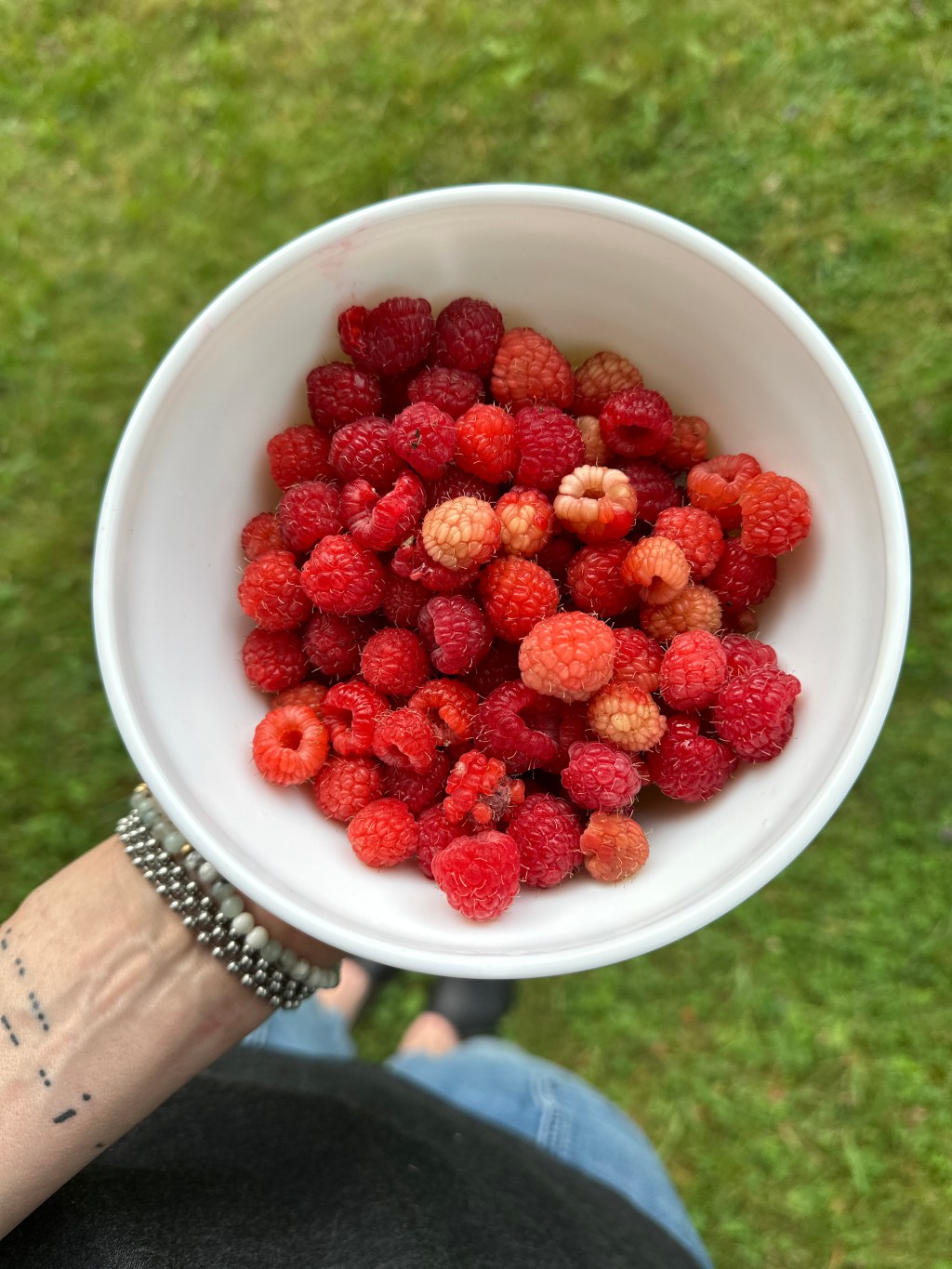
    This afternoon I slipped on my clogs and shuffled over to the raspberry patch with a bowl in my hands. I started at the base of the thicket, picking, moving up to the top methodically. I stepped into the thorns, searching for the fruits hidden beneath. There’s an art to picking berries. You look at the color first, then gently wrap your fingers around the fruit. If it slides off the branch without effort, it’s ready. Any tugging and it’s not ripe enough.

    As I picked, I thought about my son. I thought about how difficult it is as a parent to reconcile the concept that you cannot fix everything, that sometimes, despite all your efforts and love, you are not enough – and that not being enough is okay, even though it hurts like a million daggers tearing apart your heart. I thought about how much I miss him even though it’s only been three days. I heard his voice as a baby and his sounds as a teenager. I smelled his hair. I felt his warm hand in mine.

    I put a perfect red raspberry in my mouth and let it melt. I felt the taste hit my senses, the tart at my cheeks, the sweetness beneath my tongue. My eyes teared as I imagined myself as a child beneath the brambles, then my son, our voices hushed, our fingers stained. I thought about how I’d encouraged him to visit the patch a week ago and that he’d declined, withdrawn and sad, ready to move on to whatever the future was, toward the uncertainty. I remembered how much my heart hurt when he said no to joining me, that sense of loss, not just for that moment but for all the struggles and heartaches of our recent past.

    There’s a bowl of raspberries on my kitchen counter. I’d like to say that they are waiting for my oldest son, but I know that they are not. He is in California, and I am in New Jersey. He is receiving the help that I could not provide. He is not eating these raspberries, but I am. One by one, I put them in my mouth and close my eyes. I feel the taste spread like the beauty of memory sprawling throughout my consciousness. I take in the flavor and all of the wonder that flows from it and think of my child, and know that, at some point, it will be okay.

  • lost in the middle of an island

    lost in the middle of an island

    Years ago, I lived way way east on the Upper East Side, east enough that it was a hike from the last stop on the crosstown bus, literally past the last avenue. It was a tiny tiny apartment – a sixth-floor walkup – and the stairs were spiral and outside and made of stone. I loved that apartment more than almost any other place I’d live in, mainly because, despite its minuscule square footage – I think it was 250 or 300 sq ft – it had three triple-tiered windows that went from ceiling to floor, and a tiny but useable balcony, which had once been for tuberculosis patients to “take the cure” but served as an excellent spot for looking out across Manhattan and the East River. Said apartment also had a kick-ass kitchen, which is pretty entertaining given that I rarely ate or cooked in it, but having counter and cabinet space seemed like an absolute luxury when I was twenty-one years old.

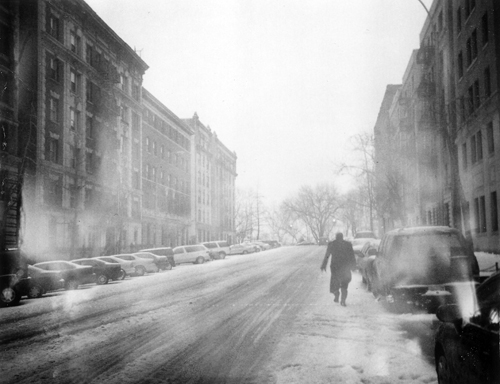
    Given its proximity to the river and the tall buildings that lined it, my street was often like a wind tunnel. I remember walking home from Lexington or the crosstown bus on frigid nights, the winter air cutting through my hat and scarf. When it snowed, which it often did in the years that I lived there, large drifts would pile up, and the swirls of white would consume the buildings like low clouds. I spent a lot of time watching the world through those giant windows.

    I remember waking one morning to a strange dimness, as though someone was cupping their hands over the sun and realized that it was snowing hard – storming – and nearly a foot already lined the streets. I love snow. I love how it mutes the world. I love the silence. I love the sense of solitude it can bring. Standing at my window that morning, I could barely decipher east from west. The streets were empty. I pulled on my running clothes and laced my sneakers tightly, then skip-slid down my six flights of outdoor stairs covered by windblown snow, flung open the gate to the building, and began to make my way west toward Central Park.

    Snow running is hard work, and by the time I reached the park, I was out of breath and sore, despite being a reasonably experienced runner, so I slowed to a trudge. I couldn’t see the roadway and paths, so I walked and listened to the sound of ice crystals falling thump thump into the pads of snow. The sun had emerged from the cloud layer, and its rays sifted through the tree branches, covered in white, like a winter understory, the snow standing in for the spring and summer leaves. I walked and wondered and listened to the sound of nothingness. There was no one else around and for a good hour, I felt like time had stopped.

    Then I got cold. Very cold. I pivoted and looked back at my tracks, now covered with a new layer of snow. I looked around and realized I had no idea where I was. I struggled to find a landmark, something familiar to give me a sense of where in the park I’d wandered to, but all I could see were trees. I panicked for a moment – these were the days before cell phones and watches with fancy GPS – and then took a deep breath and reminded myself that I was in a park in the middle of an island, and no matter what direction I walked in, I would inevitably hit one piece of the perimeter. I had run almost every inch of Central Park in daylight and darkness. It wasn’t possible to get lost, just sidetracked.

    Lifting my heavy, frozen feet, I began to run. The snow was well past 18”, so it was more like high-knee jogging, but as the blood started flowing back into my limbs, as I began to feel my fingertips and stopped obsessing over the fact that I’d had to pee for an hour and that I hadn’t brought money or subway fare, as I just fell into the ragged but still rhythmic breath that moved in and out of my lungs, as my arms pumped and heart pounded, and my eyes gained greater focus on the snowy landscape before me, I managed to find my exit. It was, of course, way north and on the other side of town, but I reached the semi-plowed street and visible sidewalks, and despite having to run an extra few miles back home, I got there eventually.

    I’ve been thinking about that morning lately – how beauty shifted so quickly to panic, how a journey through a place I knew with my eyes closed suddenly felt ominous, how lost I felt, how solitude morphed into alone, how hopelessness avalanched. Sometimes feeling lost in the known is more disorienting than being thrust into the unknown. It’s hard to remind yourself that you are also a park in the middle of an island. There are perimeters to every experience, even if they appear nonlinear. Even when storms blur things into gradients of white, there is depth beneath, there is underbrush, and there are clues to paths and exits and streets and subways and far-off rivers. Somewhere in there, the high-knee running shifts back to even strides and plowed sidewalks.

  • i move to keep things whole

    i move to keep things whole

    Recently, someone asked me if my brain ever stops churning. The short answer is not really, except for those moments when suddenly everything goes blank, and I find myself sitting on the floor of my office or lying on my couch staring at a ceiling or wall. I will admit that happens often, and I’m pretty sure it’s because I’ve used every last brain cell, and my entire being needs to recharge. I’m not saying this because I think I’m a brilliant human – it’s mostly that I don’t know how to turn my thoughts off, which for the most part, has resulted in years of terrible sleep and the amassing of large swaths of useless knowledge. Okay, not all of it is useless. I’m forty-five years old and have finally figured out how to knit most of it into something comprehensive, but my thoughts are still like one never-ending skein of yarn that is pretty consistently tangled.

    I read a lot. I love stories and poetry, but I’ve been immersed in nonfiction for the past few years. My office is filled with literature about teaching – pedagogy, art methods, and the importance of play. It’s also jammed with books about social history, autism, expressive art therapy, art history, and memoirs. My reader is clogged with research papers, some of which I’ve looked for specifically and others I’ve found while jumping down the rabbit hole of citations, which I call reference surfing. Sometimes when I can’t sleep, I sit in my comfy office chair in the dark, think about the various things I’ve read, and envision these lasers of light linking one thing to another, like how I’d imagine synapses connecting to neurons.

    I mostly chalked this frenetic research and reading and pockets of sleeplessness up to OCD (indeed, I take meds for that), as the information would swirl and repeat in my mind, and I’d find myself wondering why I was thinking about it at all, what the point was. In the past few years, I’ve realized that I was building something. It’s taken half my life, but as my mother will not hesitate to tell you, I’ve always had to do things my way, and often, I come to the space where everyone knows I should be late because I’m carving my own ever-difficult and never-linear path.

    When your mind works in haphazard ways, you often feel like you don’t fit in. You might assimilate into situations and know how to present outwardly, but inside, you feel like a weirdo amidst a sea of regular people. As a little kid, I spent much time clinging to teachers. I was desperate for understanding, even if it didn’t appear that way on the outside. I didn’t have the language for what I was thinking or feeling, and I gave up on trying to express most of it at a certain point. That resulted in years of people saying, “You care a lot about me, but I don’t know you at all.” I said to someone recently, “I know I’m a pretty closed-up person,” they looked at me and said, “Ya think?” It was said in a caring and humorous way, but that does sum it up.

    Back to the never-linear, non-stop loop that is my head. Here’s what I learned this year: all that reading and asking questions and poking around in different pockets of information and finding joy in working with children and feeling unbelievably attached to the concept of advocating for those who can’t always express themselves in what we might consider “conventional” ways? It’s super personal, but simultaneously, it’s a calling, a realization that I know what my life’s work should be. I feel an unbelievable connection with those who yearn to be heard, seen, and understood. I feel the need in every fiber of my body. It’s not an “I’ll fix it” moment. It’s a “Let’s stop, let’s connect, and let me learn about you by letting you be yourself. You don’t need to have words. Humans speak their truth in so many ways. Let me see your truths. Then let’s work on how I can help the world understand you. Somewhere in the middle, languages will converge.”

    Some people go to concerts or museums and feel their world swirl with emotion. I get that feeling when I work with kids. Everything else melts away. Their art, their movement, how they fix their gaze or even breathe becomes a language, a pattern, and sometimes a puzzle. I look at children’s minds and emotions the same way that I experience an exhibit at MoMA or close my eyes and listen to a symphony.

    My favorite poem is tattooed on my wrist in Morse code (actually, it’s just one line because I have small wrists, but it’s the best line, in my opinion). It’s spoken to me in different ways throughout life. Still, lately, I’ve wondered if the best lesson of the text is that movement – physical, mental, metaphorical – keeps many of us from fragmenting. We connect to people, the environment, and our worlds differently. That churn, that deep need to understand others the way I had yearned for as a child, keeps me whole. And I would not trade that aspect of myself for anything.


    Keeping Things Whole

    BY MARK STRAND

    In a field

    I am the absence

    of field.

    This is

    always the case.

    Wherever I am

    I am what is missing.

    When I walk

    I part the air

    and always

    the air moves in   

    to fill the spaces

    where my body’s been.

    We all have reasons

    for moving.

    I move

    to keep things whole.

  • the sound

    composite

    I am a forest person, but my richest memories have been formed on the shore. I grew up there, feet numbed to the rocky northern coastline, face salty, lungs stiff from seawater, hair bleached white from the sun. As a child, my mother shared stories of her youth – summers spent on a similar slice of shore, away from the city heat, in the 1950s when eastern Long Island was just on the verge of development. I would trace my fingers across square black and white photographs as I listened, faded pictures of twin girls standing in the sand, the same tousled hair as I would have three decades later after long days watching the tide ebb and flow, after building sand tunnels and trapping jellyfish, after warm, gritty peanut butter sandwiches and sunburnt shoulders.

    My aunt died of cancer at forty-nine. Before her battle ended, back when she was still in her apartment on West 84th, when I was still walking across town to help with groceries and late-night trips to the hospital, we took a walk. We hobbled past Zabar’s and Fairway, and then, tired, she asked to rest by the river. We sat together quietly at first, and then she talked about family. She spoke of dying. She told me that her greatest fear was being forgotten.

    My father called the morning before her death to tell me it was time. By then, she had moved in with them, her hospital bed in our den, and later, in hospice. I remember the train ride east from Penn Station, the rush of the city disappearing, swallowed by suburbs, the blur of fall foliage.

    After her last breath, after our goodbyes and the grieving and relief, once the night wrapped around us, I climbed into my mother’s car and drove down to the shore in the darkest of darkness. At the turnoff from North Country, I shut off the headlights, moving fast and blindly, steering only by the feel of the curves. I knew them by heart. It was like driving with my eyes closed, except they were open and encased with heartache.

    At the beach, I climbed a lifeguard chair. It was a clear night, cold. The waves crashed, barely visible in the darkness. I could see Connecticut shimmering just beyond the horizon, a razor-thin line of light defining water from the sky. I sat on the giant wooden chair and cried harder than I thought possible. I cried until I gagged and gasped for air, until my lungs and ribs felt bruised, until my head ached. Once empty, I took a running jump off the chair, spread my arms wide, and felt that brief moment when time was suspended, the millisecond before my body tumbled downward, slow then fast, to the damp sand below.

    Years later, my mother told me she’d driven her sister to the beach days before she died. My aunt had longed to see the beach but was too weak to leave the car. They sat in the parking lot, watching the gentle surf. Twins returning to the shoreline.

    Eventually, my parents sold the house and moved north. I didn’t return to my childhood beach until almost a decade later when I was heavily pregnant with my first child. We had set out east to go apple picking, to buy a pie at a stand that I’d remembered as a little kid, but en route, I longed to get off the ugliness of the main roads, and we detoured to the sound. The beach was the same as when I was six and sixteen and twenty-one, empty in the late September sun, the shore still beautifully rocky, the smell of salt and seaweed, the clam and mussel shells, the weathered sea glass.

    The week before my first child was born, as my husband and I stood together on the shore of northern Long Island, I thought about the journey we were about to embark on, the unknowns, the possibilities, the fears. I imagined the joys and the heartbreaks and the ordinary moments in between. I thought about the strength of the moment on the cusp of motherhood. I thought about the fragility of life.

    I dipped my toes into the cool sand and felt the humid breeze against my cheek. I placed my hand on my swollen belly and looked toward a lifeguard chair. I thought about that painful night and remembered the numbness of driving in complete darkness, hurtling through unbearable emotions, half wishing that the car would cut a curve too close, that it would careen out of control so that I just wouldn’t have to feel. I looked across the sound to the tiny speck of Connecticut glittering in the afternoon sun.

    I envisioned my aunt. I imagined what she might have looked like as a child running down the shore of Wading River. I remembered her smile, steadying her bike with one hand as we talked, having run into one another on La Guardia Place. I conjured that moment on Riverside, her body weak, on the brink of her last journey.

    I wish she could have known then that her memory is always with me, that for years I would walk by her apartment building and trace my finger across her last name on the buzzer, which remained there for years until the building was sold. I wish she could have known that when I ran my first NYC Marathon, I ran it for her, repeatedly saying her name in my mind as I crossed through each borough, that I smiled and burst into tears at the finish line, that I’d carried a small photocopy of her portrait folded in the pocket of my shorts.

    I wish she could have known that my oldest child’s name is hers, that I knew that day, feet digging into the sand, heart filled with remembrances, that I could capture a tiny piece of her, of us, in a new and vibrant life to come. I can’t know for sure, but perhaps she knew, somewhere in there, that the rocky shore and sea salt air was a bond we carried together in our blood, in moments that, while not congruent, were unspoken, soft reminders, memories in the lapping waves.