object of memory

we must return to where it was lost / if we want to find it again

Tag: mental health

  • i feel numb, burn with a weak heart

    i feel numb, burn with a weak heart

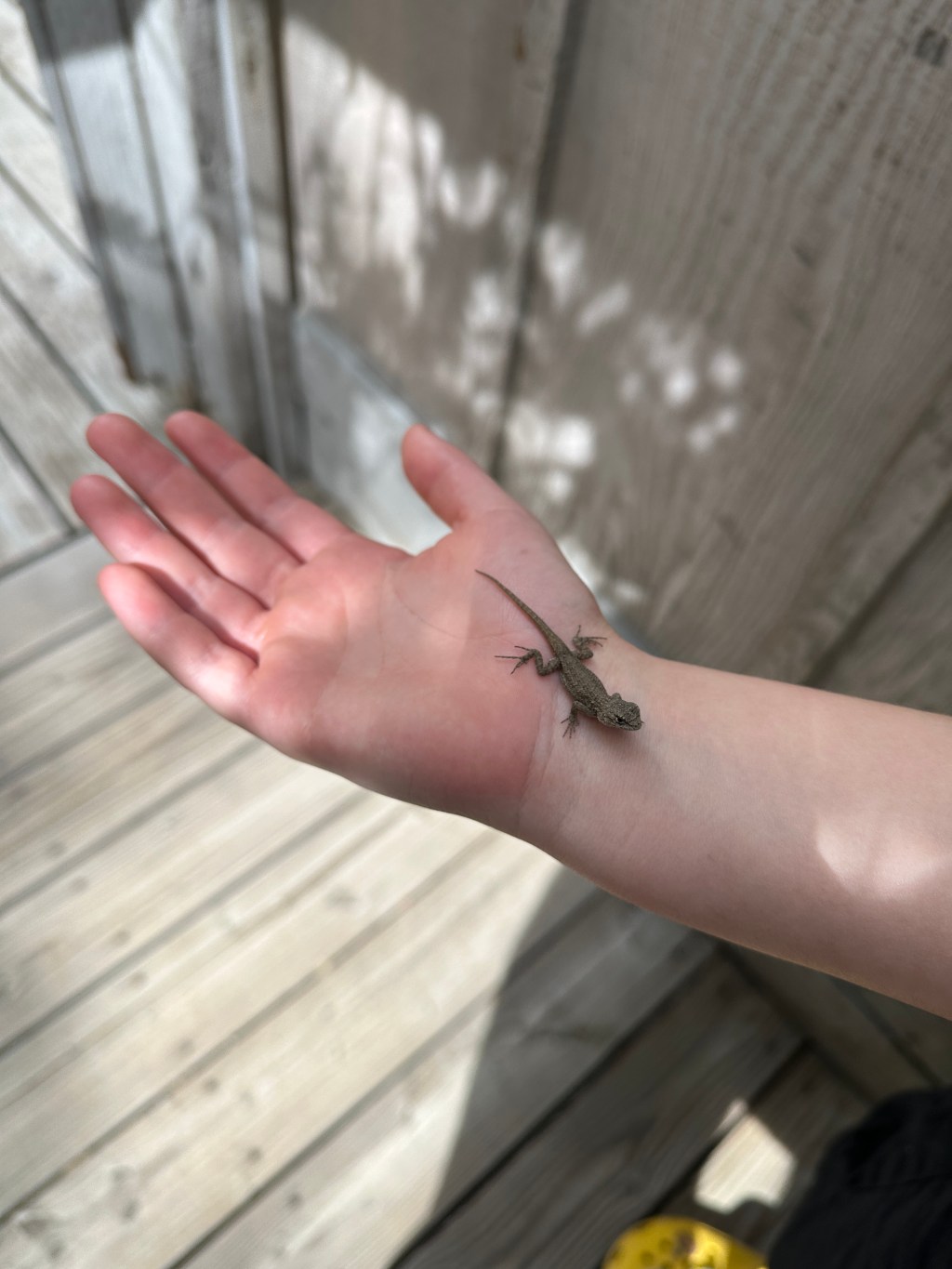
    My family has a Labor Day tradition – a trip to the shore without me, because to be blunt, while I love beaches, I am not a fan of sitting on them in the blaring sun. I am more of a rocky, cold, rough water, and sparsely populated beach person, which is the exact opposite of the Jersey Shore. Tradition dictates that I remain in our home with the dog, three cats, and a very antisocial and possibly blind lizard. I don cruddy clothing and pajamas and chip away at the layers of our house that come from living with three humans who cannot part with anything. In short, they leave, and I donate things and throw a lot away. It is my favorite weekend of the year.

    This is why I am sitting in the dark at my kitchen table, the moon’s glow filtering through the skylight, apologizing to a parent whom I just spammed with things to think about for the school year, not realizing it is past midnight. I have five browser windows, three documents, and four email accounts open on my screen. I am bouncing between discussions with schools, lawyers, clinicians, my own teaching/caseload, a course presentation that is due soon, a creative writing piece that I can’t seem to push out words for, and a pleasure project that I am slowly hedging through that involves rewriting Sol LeWitt’s sentences on conceptual art for preschool (because OMG, it works. It. Works.). I’ve only been able to sit still to work on the above because of the satisfaction gained from organizing the garage and both kids’ rooms and 85% fixing the rusted ball joint on our basement bathroom sink stopper.

    That was a very long way of explaining how one person in this giant world regulates herself during a period of deep sadness. I write this not because all is doom and gloom because it’s not, but because sometimes we need to acknowledge the strange mass of Vantablack in the room. In my case, that’s grief.

    I tackled one of the messier spaces in our house a few hours ago – a small sunroom that holds an exercise bike, a few weights, and our PC and printer. It was filled with piles of crap – both kids’ unemptied backpacks from last year, random pieces of paper, baseball and Pokémon cards, Sid’s art supplies, and all of the phone chargers I have been looking for over the last twelve months. I emptied Emmett’s pack first, then scooped the playing cards into a box to be sorted. I pulled out unused supplies that could be used this year and paused for a second to sigh and lament that my baby is now in his last year of elementary school. Then, it was time to go through Sid’s things.

    Sid has been away for seven weeks, and we are preparing for his next step, which likely will not be at home with us. I cannot express how difficult this has been for the entire family, and each time we get over one hump, another higher hill of emotion awaits. I am incredibly proud of my child and of all four of us. Healing – understanding and learning from how each of us communicates, tackling and sitting with excruciating feelings, navigating the should have / could have / wish we had threads of guilt – is really fucking hard work.

    I had spent the morning on calls and email back and forths about my child’s future, and then took my seething anger at the American school and mental health systems and channeled it into cleaning out the refrigerator. When I finally went through Sid’s backpack, I was blasting music on the turntable because I needed to feel it reverberate through my everything. Plus, it can’t hurt to dance a little.

    So, I was dancing on the gross carpet after chucking half-completed homework assignments and old candy wrappers into the garbage when I realized I was hugging Sid’s backpack. I had pulled the canvas close to my chest, my fingers rubbing the material, and the lyrics Home is where I want to be / Pick me up and turn me round /I feel numb, burn with a weak heart / I guess I must be having fun ran through my brain like razors of emotion. I curled around the backpack, kneeling on the half-cleaned floor, and sobbed. I cried hard and then hung his things in the hall closet and stood in the clean, empty living room and listened to the needle tracking on the record’s dead wax, the crackle of no sound, and thought to myself, did I just hurt so hard that I feel nothing, or did I open wide until the emotions completely filled me?

    I’ve been thinking a lot about that irony of emptiness. A room can appear so full but actually be vacant; conversely, an empty space can be so full of memory. In these days of intensity, these moments that trigger the need to cleanse and organize and reorganize and seek sense and order, the fullness feels so empty, and the emptiness so full.
  • and never trust a heart that is so bent it can’t break.

    and never trust a heart that is so bent it can’t break.

    It’s been a while. I’ve had a lot to say but not a lot of words, if that makes any sense. Summer began and passed and here we are almost at the cusp of school starting. I’m not sure if I have much to show for it other than work hours logged, a few good books read, and some intensive therapy – and I’m transparent about that one because these things need to be more at the forefront of conversation. Humans can be fragile and strong at the same time. I used to think that it was a balance but these days I feel that it is a composite, for there is strength in fragility and, conversely, strength can be fragile.

    I am sitting with a beer at SEA-TAC, waiting for my red eye flight home. Four hours ago I was in California hugging Sid for the first time in almost two months and then navigating a flimsy rental car through a canyon of giant flood puddles and mudslides and rocks and pretending that I could see the road on the 405. Apparently there was an earthquake in Ojai around the time that my first flight took off. Seattle is sunny and warm and full of forest fire smoke. I don’t think it’s dramatic to say that the world is upside down.

    This has been the summer of hard feelings – encountering them, acknowledging them, facing them, feeling them. I’ve never been good at any of that. I have always felt things deeply but received a D- in the processing department. If anything, I will complete this summer with a degree in feelings. Take that, Harvard.

    I’m not even sure what highway I was on this morning – maybe 14 – en route to the 405, hustling to try and get ahead of the flooding and feeling guilty for not spending the full allotted four hours with my kiddo, but also cognizant of the fact that if I missed my flight, I wouldn’t be home until at least Tuesday. I’d spent the night in a random hotel, blackout drapes drawn, diving into and surfacing from intense dreams that left me covered in sweat, shaking so hard that I thought I would be sick. The rain barreled down onto the road, so much so that the car sensor registered that I had crashed the front. It kept dinging and flashing for a good half hour, the camera obstructed by sheets of water. Every so often, the car would lift with a surge, and I’d grasp the steering wheel tighter, training every thought on the lyrics of Bright Eyes songs that I’d set up to play, album by album, from my phone.

    The rain reminded me of a trip my husband and I took to Turkey shortly after we were married. We drove from Izmir to Cappadocia, stopping in various towns and cities along the way, and at one point we were driving up a mountain behind an oil truck that was moving exceedingly slow. When it finally let us pass, our car was pelted with hail, and we realized quickly that the slowness and largess of the truck had been shielding us from the harsh reality of our future. When this memory hit, tears ran freely down my cheeks. I wasn’t making a sound, but the physicality of the emotions surfaced.

    Much of this summer has been acknowledging the fact that I have been using life like that oil tanker, the feelings like hail just out of view. At some point that truck is going to pull over and the natural elements will reach you. So, here I am with a lot of dents and scratches. I think the hail has gotten smaller, though sometimes the smallest balls of ice sting the most.

    In other news, Sid has been connecting with farm animals, and one of the chickens is named Patricia.

  • stepping off the gravitron

    stepping off the gravitron

    Things I have learned in the last two weeks in no particular order:

    1. The house is exponentially quieter with one child vs. two.

    2. The house is still just as messy.

    3. Once there is quiet, you realize there are so many layers to peel back, wade through, or hide beneath.

    4. After several years of being on edge, the brain doesn’t know what to do with itself.

    5. The body retaliates after several years of being on edge.

    6. Sleep is a fickle creature that evades at night and then attacks during the day.

    7. Music is solace. The more I listen, the more I hunger for a thrumming beat, rhythm that pushes my body into movement, for sounds that vibrate through my entirety.

    8. Perhaps I am starved for the feeling of wholeness and am attempting to fill it with sound.

    9. Or maybe the sound reminds me that I am alive.

    10. My lynx point Siamese rescue kitten will eat half a loaf of challah if we leave it on the counter.

    11. My orange cat curls around my head each night and purrs like he is gifting me a lullaby.

    12. My tuxedo cat has started sleeping in my oldest child’s vacant room.

    13. I am tired of using oldest and youngest to name my children, so I’ve created pseudonyms: oldest = Sid, youngest = Emmet

    14. I talked to Sid on Zoom today – it was the first time in fourteen days that I could see his face – and the distance felt so stark, immovable, and overwhelming.

    15. Ravens are living in the trees near my house.

    16. Their screams are fabulous.

    17. Mid-summer magic hour, when the lightning bugs begin to rise, will always be magical.

    18. One day, millisecond by second by minute by hour, I will stop feeling like I have just stepped off a Gravitron.

    19. One day the pieces will fall back into place. Likely not the same place, but adjacent, with edges that line up just enough but not quite, which is good enough for me.
  • in the thicket

    in the thicket

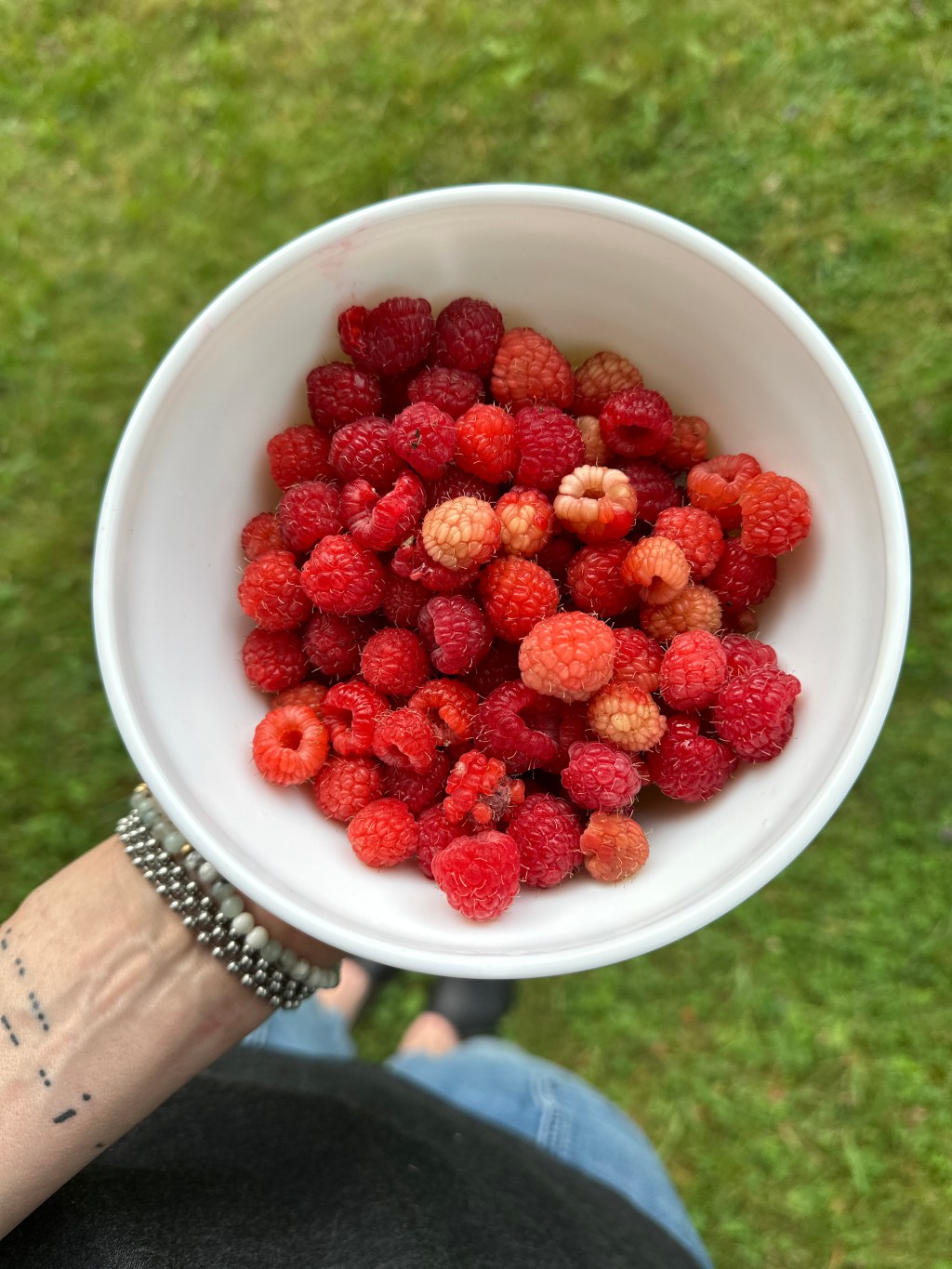
    I grew up with a giant patch of wild raspberries. I would duck beneath a bow of leaves and thorns, and my backyard would disappear. Instantly I was transported into a forest of rubies. They hung heavy from the branches, and the brambles were so dense that birds could not penetrate the understory. I remember many mornings sitting on the ground, filling my mouth with the tart and sweet magic, getting mauled by mosquitoes but not caring, as the berries were just once a summer and sometimes in early fall, and their taste was unrivaled.

    I left the house this afternoon for the first time in several days. Life has been like that lately – I turn around and am unsure of where I am in time. I’ve been hiding a bit, hesitant, and aware that my head feels thick and slow and that it’s been a challenge to keep up with conversations. We have been in survival mode for over a year. Now that some of the restraints have been lifted, it’s been hard to know what to do, think, and how to feel.

    A raspberry patch is in a school garden across the street from my house. I began caring for it during the pandemic. It was overgrown with trees and weeds, and I spent hours working the soil and protecting seedlings from hungry birds and squirrels. Someone had planted raspberry canes. I trimmed them dutifully for three years, confining them to one raised bed.

    I couldn’t bring myself to grow or care for anything this year. Spring came and went, and I did not turn the soil in my backyard for peas and tomatoes. I didn’t touch the school garden. I couldn’t deal with the idea of having to help something survive, probably because every fiber of my being was dedicated to ensuring that my oldest child remained on this earth. My survival, in so many ways, depended on his.

    My oldest loved raspberries since the moment he began eating solid foods. He is the first one by my side when we gather blackberries in Vermont or strawberries at a local farm. The past few summers, I’ve gone out early to pick the school raspberries, then left a bowl for him on the kitchen counter. Even at eleven and twelve years old, he’d put the berries on his fingertips to eat them, and each time he went through the process, my heart would melt. Every so often, I’d have a dream where he and I were crouched beneath the brambles collecting the red fruits in our cupped hands, his blond curls glinting in the filtered sunlight. I am used to him by my side each summer, picking those berries. But this summer, he’s not.

    This afternoon I slipped on my clogs and shuffled over to the raspberry patch with a bowl in my hands. I started at the base of the thicket, picking, moving up to the top methodically. I stepped into the thorns, searching for the fruits hidden beneath. There’s an art to picking berries. You look at the color first, then gently wrap your fingers around the fruit. If it slides off the branch without effort, it’s ready. Any tugging and it’s not ripe enough.

    As I picked, I thought about my son. I thought about how difficult it is as a parent to reconcile the concept that you cannot fix everything, that sometimes, despite all your efforts and love, you are not enough – and that not being enough is okay, even though it hurts like a million daggers tearing apart your heart. I thought about how much I miss him even though it’s only been three days. I heard his voice as a baby and his sounds as a teenager. I smelled his hair. I felt his warm hand in mine.

    I put a perfect red raspberry in my mouth and let it melt. I felt the taste hit my senses, the tart at my cheeks, the sweetness beneath my tongue. My eyes teared as I imagined myself as a child beneath the brambles, then my son, our voices hushed, our fingers stained. I thought about how I’d encouraged him to visit the patch a week ago and that he’d declined, withdrawn and sad, ready to move on to whatever the future was, toward the uncertainty. I remembered how much my heart hurt when he said no to joining me, that sense of loss, not just for that moment but for all the struggles and heartaches of our recent past.

    There’s a bowl of raspberries on my kitchen counter. I’d like to say that they are waiting for my oldest son, but I know that they are not. He is in California, and I am in New Jersey. He is receiving the help that I could not provide. He is not eating these raspberries, but I am. One by one, I put them in my mouth and close my eyes. I feel the taste spread like the beauty of memory sprawling throughout my consciousness. I take in the flavor and all of the wonder that flows from it and think of my child, and know that, at some point, it will be okay.

  • i move to keep things whole

    i move to keep things whole

    Recently, someone asked me if my brain ever stops churning. The short answer is not really, except for those moments when suddenly everything goes blank, and I find myself sitting on the floor of my office or lying on my couch staring at a ceiling or wall. I will admit that happens often, and I’m pretty sure it’s because I’ve used every last brain cell, and my entire being needs to recharge. I’m not saying this because I think I’m a brilliant human – it’s mostly that I don’t know how to turn my thoughts off, which for the most part, has resulted in years of terrible sleep and the amassing of large swaths of useless knowledge. Okay, not all of it is useless. I’m forty-five years old and have finally figured out how to knit most of it into something comprehensive, but my thoughts are still like one never-ending skein of yarn that is pretty consistently tangled.

    I read a lot. I love stories and poetry, but I’ve been immersed in nonfiction for the past few years. My office is filled with literature about teaching – pedagogy, art methods, and the importance of play. It’s also jammed with books about social history, autism, expressive art therapy, art history, and memoirs. My reader is clogged with research papers, some of which I’ve looked for specifically and others I’ve found while jumping down the rabbit hole of citations, which I call reference surfing. Sometimes when I can’t sleep, I sit in my comfy office chair in the dark, think about the various things I’ve read, and envision these lasers of light linking one thing to another, like how I’d imagine synapses connecting to neurons.

    I mostly chalked this frenetic research and reading and pockets of sleeplessness up to OCD (indeed, I take meds for that), as the information would swirl and repeat in my mind, and I’d find myself wondering why I was thinking about it at all, what the point was. In the past few years, I’ve realized that I was building something. It’s taken half my life, but as my mother will not hesitate to tell you, I’ve always had to do things my way, and often, I come to the space where everyone knows I should be late because I’m carving my own ever-difficult and never-linear path.

    When your mind works in haphazard ways, you often feel like you don’t fit in. You might assimilate into situations and know how to present outwardly, but inside, you feel like a weirdo amidst a sea of regular people. As a little kid, I spent much time clinging to teachers. I was desperate for understanding, even if it didn’t appear that way on the outside. I didn’t have the language for what I was thinking or feeling, and I gave up on trying to express most of it at a certain point. That resulted in years of people saying, “You care a lot about me, but I don’t know you at all.” I said to someone recently, “I know I’m a pretty closed-up person,” they looked at me and said, “Ya think?” It was said in a caring and humorous way, but that does sum it up.

    Back to the never-linear, non-stop loop that is my head. Here’s what I learned this year: all that reading and asking questions and poking around in different pockets of information and finding joy in working with children and feeling unbelievably attached to the concept of advocating for those who can’t always express themselves in what we might consider “conventional” ways? It’s super personal, but simultaneously, it’s a calling, a realization that I know what my life’s work should be. I feel an unbelievable connection with those who yearn to be heard, seen, and understood. I feel the need in every fiber of my body. It’s not an “I’ll fix it” moment. It’s a “Let’s stop, let’s connect, and let me learn about you by letting you be yourself. You don’t need to have words. Humans speak their truth in so many ways. Let me see your truths. Then let’s work on how I can help the world understand you. Somewhere in the middle, languages will converge.”

    Some people go to concerts or museums and feel their world swirl with emotion. I get that feeling when I work with kids. Everything else melts away. Their art, their movement, how they fix their gaze or even breathe becomes a language, a pattern, and sometimes a puzzle. I look at children’s minds and emotions the same way that I experience an exhibit at MoMA or close my eyes and listen to a symphony.

    My favorite poem is tattooed on my wrist in Morse code (actually, it’s just one line because I have small wrists, but it’s the best line, in my opinion). It’s spoken to me in different ways throughout life. Still, lately, I’ve wondered if the best lesson of the text is that movement – physical, mental, metaphorical – keeps many of us from fragmenting. We connect to people, the environment, and our worlds differently. That churn, that deep need to understand others the way I had yearned for as a child, keeps me whole. And I would not trade that aspect of myself for anything.


    Keeping Things Whole

    BY MARK STRAND

    In a field

    I am the absence

    of field.

    This is

    always the case.

    Wherever I am

    I am what is missing.

    When I walk

    I part the air

    and always

    the air moves in   

    to fill the spaces

    where my body’s been.

    We all have reasons

    for moving.

    I move

    to keep things whole.