object of memory

we must return to where it was lost / if we want to find it again

Tag: nature

  • sing a song of seedlings found

    Ginkgo trees can live 1,000 years or more. They are living fossils. They’ve mingled with dinosaurs. They’ve survived some of the harshest conditions, including the atomic bomb and, most notably, New York City streets. They are strong. Survivors. And they start as tiny seedlings.

    I found one this summer. I was petting a stray cat in Prospect Heights and saw one making its way up and out of very dry soil in a sidewalk crack. The cat was disinterested, but the baby ginkgo couldn’t say no, so I scooped it up in my hands and carried it with me to dinner with a friend in Park Slope. It was a beautiful night, and the waitress placed three glasses on our outdoor table. “Here’s one for your baby tree,” she said nonchalantly, and I plunked the parched roots into the ice water, drank some nice wine, and had a great evening.

    No one in Penn Station bats an eyelash at a sweaty middle-aged lady clutching a ginkgo seedling wrapped in a damp paper towel at 10 pm while waiting for New Jersey Transit. My husband didn’t, either, as he’s known me for twenty years, and it is not unusual for me to return home from an outing with some living thing in tow, and I am sure he was relieved that it was a tree and not a cat.

    Ginkgo saplings grow slowly. They are the antithesis of bamboo, which you can witness – even hear – growing if you are still and patient enough. Ginkgoes are giants that take their time. They are saving their energy for survival. I think that is why I’ve always loved them.

    I tend to pick things up from the ground to save when I want to remember moments. I have stones that hold all sorts of memories – saying goodbye to my best friend when she left for college, hag stones from a beach walk in San Francisco days before Sid was admitted to the hospital. I have water chestnuts Emmett slipped into my hand while visiting Valentino Pier and horse chestnuts I’ve pocketed on walks through my town alone, savoring the fall air and leaves.

    A few months ago, on a walk with our dog, I scooped up a few burr oak acorns. It was a pretty unhappy time, and the act of picking up the seeds was partially one of desperation. Maybe, I thought, I can make these grow. Maybe, I wondered, if they sprout, I will make it through. When I got home, I wrapped them in a damp towel, shoved them into a plastic bag, and left it on my office windowsill. Then I forgot they were there until December.

    burr oak & helen frankenthaller

    When I opened the bag, I anticipated mold and foul smells, but instead, it was an earthy musk of life. Pushing out of three of the four nuts were strong, thick roots. I held them in my hand, marveling at nature’s ability to do its thing in the dark of a wadded-up wet paper towel, then placed each in water and watched them grow. Unlike ginkgoes, oak trees are speedy. Within a week, two seeds had leaves. I moved one to an old bourbon bottle last weekend as its roots had become too complicated to reside in a salsa jar.

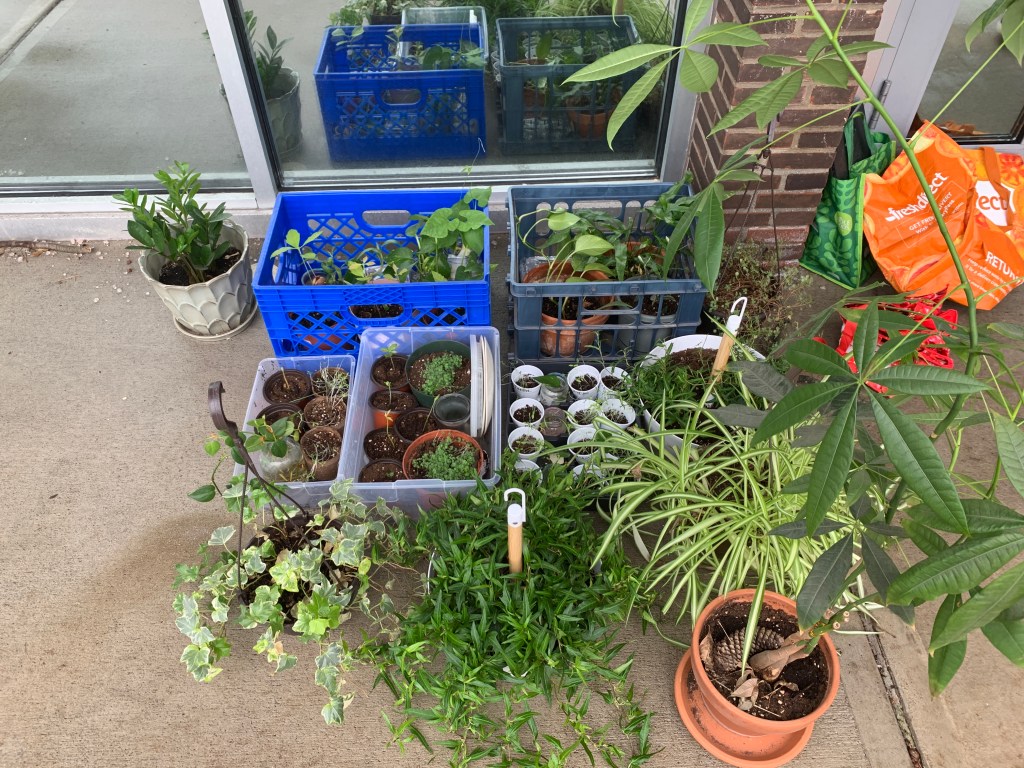
    I probably should plant the oak and the ginkgo outside in the spring or fall, but I’m selfish and want to keep them close. When I watch their roots and leaves spread, their stems move incrementally toward sturdy trunks; it reminds me of how instinctual survival is. I want to grow with them. I want to survive with them.

  • stuck

    I got stuck a lot this week.

    Stuck outside when I was trying to move my classroom from one room to another and the worst sounding fire alarm in the world went off and I forgot my key card inside.

    Stuck on NJT somewhere between Secaucus and Newark Broad for 90 minutes and in an airless, broken-down train before we were “rescued” and pushed back deeper into NJ.

    Stuck in general.

    I found this leaf while waiting to return to the pretty vacant (fall break) school building. The coloring was so gorgeous. It was a tiny sapling pushing up through two pieces of brick retaining wall.

    I guess one might have thought it was stuck, too, but in retrospect, it was more likely reaching toward survival.

  • all things grow, all things grow

    all things grow, all things grow

    The New York Times recently published an article about the Folly Tree Arboretum. It was in the Styles section, which I found quite odd, but I guess Folly Tree is on the Eastern Fork of Long Island, so it qualifies as stylish. Regardless, the arboretum combines three giant pieces of my heart – narrative, memory, and nature. You can read about it here.

    My brain always trends toward the vernacular. History is awesome, and momentous events deserve mention, but my passion sits in the magic of everyday memories – the experiences that you or I have individually or collectively, interactions and exchanges that someone else might find mundane or irrelevant, but when looked at within the context of the personal or collective landscape, have meaning.

    I studied the history of New York City architecture in grad school. While I deeply appreciated historic preservation, I consistently found myself drawn to the stories within the walls. Who lived there? What was their life and community like? What were their narratives? More often than not, I was interested in vernacular architecture – buildings that might otherwise be overlooked by preservationists (though this has changed somewhat) but held sociocultural meaning when looked at against the landscape of time.

    It’s been a long, long time since I’ve had the quiet space to navel gaze, and recently, I’ve dipped my toe back into the activity in an attempt to remember and revivify who I was five years ago, before the pandemic, before all of this family upheaval. As I explained to a friend recently, I’m not entirely sure what makes me happy anymore. Reading about Folly Tree reminded me of those tiny sparks within. Narrative keeps my soul afloat, and if you peek into my home, you will find myriad objects that I have kept – my objects of memory – that tell the stories of my life.

    Oak trees produce acorns in cycles. There was a bumper crop in the fall of 2019, and in early 2020, they emerged from their wintering. One of my favorite things to do with preschoolers is plant seeds, and when I noticed several acorns near my house beginning to germinate in decomposing leaves, I brought them to my 3s classroom. Each child planted an acorn and then asked for more. We spent a good chunk of January and February exploring seeds from their foods at home – apple, lemon, avocado, etc. In early March, one child brought in dragon fruit seeds, and we curiously planted the tiny specs in peat pots and put them in the window.

    In mid-March, the world shut down. On Friday the 13th, I packed the kids’ plants into my car and took them home from school. We were told “two weeks,” but I knew it would be longer, so I arrived home with a greenhouse of seedlings and placed them all over the kitchen. We all know where this story goes. We didn’t go back. I taught through the entire pandemic, albeit outside; most kids in our town didn’t set foot into a normal classroom for a year and a half.

    I now know that my reaction to the pandemic was outsized – it fused together a bunch of baggage that has taken several years for me to identify and begin to disentangle – but my initial urge, or perhaps agony, was that I wanted to keep every child safe. I couldn’t do that, nor was it my job to do so, so when I wasn’t riding my bike to kids’ houses and trying to keep them company on their sidewalks, I was taking care of oak and dragon fruit sprouts. And they grew. They grew and grew and grew.

    Not all of them survived. When we returned to school somewhat normally but “with an abundance of caution” in 2021-22, one oak tree and two dragon fruit plants remained. I taught kindergarten that year, and one of the students from my pandemic 3s class attended. When I saw her, now almost six years old, my heart burst into a million pieces, as her oak tree was the one that had survived.

    I carried the sapling back to my school with a shovel and trowel that fall. During one of our outdoor play periods, that child and I dug a deep hole in the wooded area where the kids ran about, and we planted her tree. It looked like all other trees around it – a spindly baby oak, its leaves dropping – and no one would have known its importance. But I did. It was the acorn that survived. It was grief and helplessness and passion and hope. It was a moment passed and a living memory. And a future that continues to grow.

    The beautiful thing about memory is that it’s always vernacular. What one holds as precious, another may never fully understand. But our memories can be like forests. We all have our oak trees – the tiny acorns that woke in their beds of decomposing leaves, growing within our experience’s conditions and standing tall together. Our stories are all different but they make up the collective, and in that, there is so much power.

    [Note: The dragon fruit plants still live in my kitchen!]