I clearly remember the day that I bought my first camera. I remember the weather, still warm with the last gasps of summer but with a crispness that cut through the lingering humidity. I remember waiting at the counter at West 17th Street for my Pentax K1000 to make its way through the pulley system and into my hands. I remember sitting on the sidewalk and opening the box immediately, loading in the film.
All my photographs from the early 90s onward were taken on that camera. I knew it so thoroughly that sometimes I wondered if the camera body had slowly molded itself to where my fingers sat, the path they used to navigate the f-stops, the film wind. I cannot think of my early adult life in New York without the Pentax coming into frame.
I’ve always had some form of manual camera around, though the transition to digital was inevitable and, for the most part, more cost effective. I still print snapshots for our family photo albums – maybe I’m one of the last people on earth who do that, not sure – and while I don’t fancy myself a photographer by any means, I do enjoy the act of photography, and there’s something about the intentionality and slowness that is calming. When I press down on the shutter, moment becomes memory.
I began taking photographs again during the height of the pandemic. There was a terrifying stillness to the chaos, a dense fog that slowed time, a strange disembodiment that contradicted the intensity of emotion. Most of my photographs were of my children: Emmett’s face pressed flat against the cold kitchen floor amidst a Chromebook glow, Sid with freshly dyed bright red hair, and also empty spaces, like preschool playgrounds and swing sets surrounded by police tape. I began calling them “real photos” when I shared with friends – select moments transcribed to memory. I know that all pictures are photographs but these felt different.
The Pentax is gone. We have a nice collection of near-obsolete cameras, and I dug through every box to no avail. My guess is that somehow it was lost in a move, or perhaps it’s in this house somewhere. I looked again yesterday, hoping to miraculously find it for immediate use, but it wasn’t there and I knew it wouldn’t be, sort of like when you spend a few decades in a place and know every building and sidewalk crack by heart, then leave and know that most of the row houses are luxury condos but you look for that one favorite building anyway, just for disappointment’s sake.
I took my Fujifilm to Brooklyn instead. I wasn’t entirely sure what I wanted to capture but I found myself slinging it over my shoulder as I hustled for the train. I spent the afternoon and evening wandering with a friend, no plan in place, my favorite activity, threading ourselves through neighborhoods, our verbal narratives weaving in and out of the landscape. I kept going back to the concept of collective solitude, something that I have always felt in New York, and that is probably why I love it so much, why it touches a piece of my interior world. Prudence Pfeiffer uses the term in the introduction to The Slip, and I think she hits it perfectly.
Collective solitude…is about being together in a specific place and time, without denaturing each individual story. It’s about knowing that there are others around you—above and below, just down the block—who are also trying to work out how to make something compelling, and how to survive while doing it. But also knowing that you are alone and free.
The Historical Present: Collective Solitude at Coenties Slip
The essay and book are centered around a model of creativity but I also read it as my lived experience in the city that is so much part of my being, as well as the lived experience in that specific set of moments with my friend as we navigated our personal worlds, our interconnected ones, and broader collective of city dwellers and tourists and space and place.
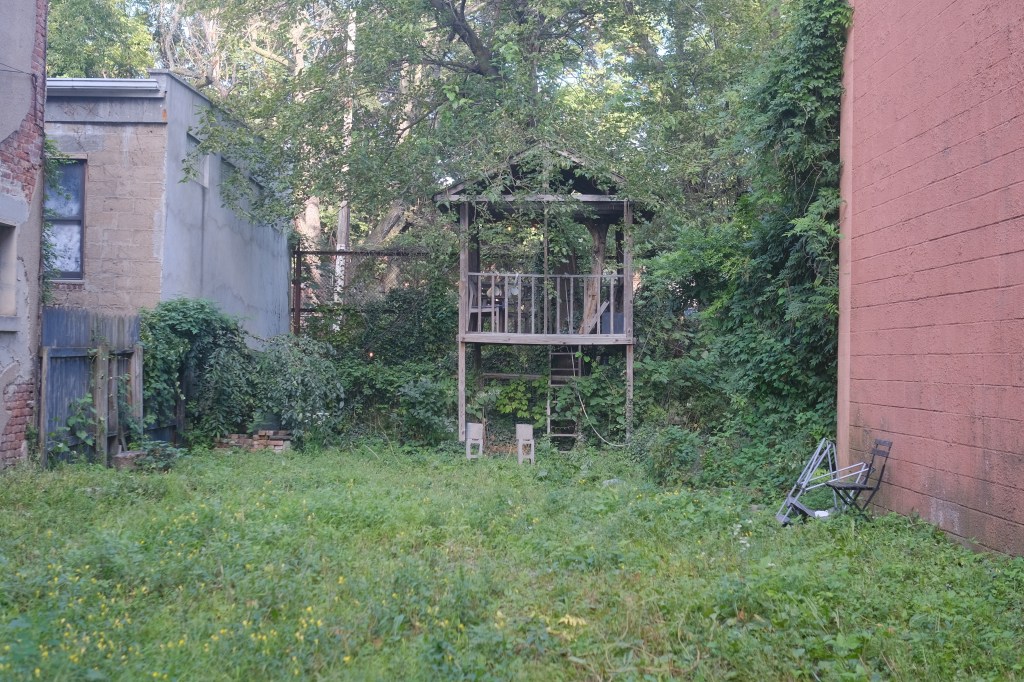
When I use a manual camera I don’t look at the photos until I get them to my computer. It’s a personal rule, mostly because it forces planning when the photograph is taken, versus the phone camera dance of snap fifty photos and edit them down and then never look at them again once your camera roll gets too full and the cloud eats everything. I must have been paying attention to the photographs that I took – there were ten in total, all fairly composed – but when I reviewed them this morning 75% were of seeds and unruly but intentional plants with a few favorite buildings and social commentaries thrown in for flavor. I scratched my head for a moment and then smiled, as those were indeed the “real photos” of such a perfect day.
On the kitchen table, neatly organized in rows, were the objects that signified moments that captured feelings – an osage orange fruit, thorny fuchsia seed pods, and a baby ginkgo tree that the server where we sat savoring a glass of wine and tapas as the sun set asked so naturally, “Should I bring a water glass for your tree friend, as well?”
As all nature is, these objects are ephemeral. The pods will dry and lose their color. I will plant a few of the seeds. Verdict is out on the ginkgo tree, though I have a transition pot ready. And then there are the real photos. Silly pictures of plants found in nooks and crannies of Vinegar Hill and Fort Greene and all the places in between. Images of not just objects but off camera discussions and facial expressions and sighs and laughter and shared memories and individual experience. Real photos.
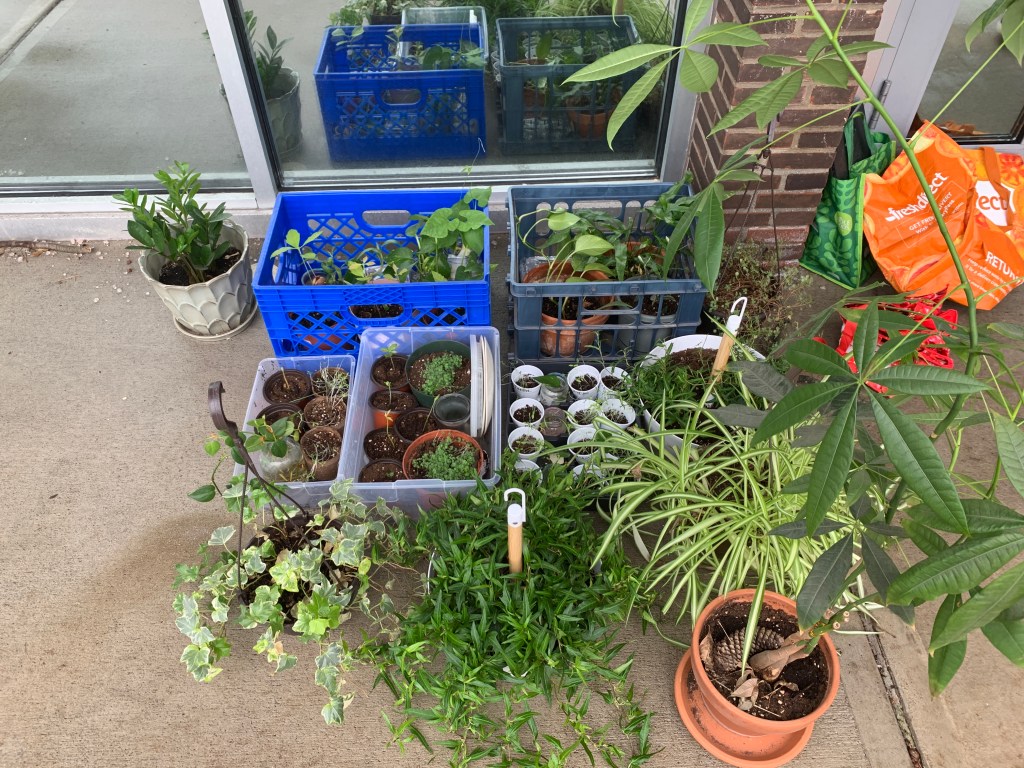
 object of memory