object of memory

we must return to where it was lost / if we want to find it again

Tag: teaching

  • all things grow, all things grow

    all things grow, all things grow

    The New York Times recently published an article about the Folly Tree Arboretum. It was in the Styles section, which I found quite odd, but I guess Folly Tree is on the Eastern Fork of Long Island, so it qualifies as stylish. Regardless, the arboretum combines three giant pieces of my heart – narrative, memory, and nature. You can read about it here.

    My brain always trends toward the vernacular. History is awesome, and momentous events deserve mention, but my passion sits in the magic of everyday memories – the experiences that you or I have individually or collectively, interactions and exchanges that someone else might find mundane or irrelevant, but when looked at within the context of the personal or collective landscape, have meaning.

    I studied the history of New York City architecture in grad school. While I deeply appreciated historic preservation, I consistently found myself drawn to the stories within the walls. Who lived there? What was their life and community like? What were their narratives? More often than not, I was interested in vernacular architecture – buildings that might otherwise be overlooked by preservationists (though this has changed somewhat) but held sociocultural meaning when looked at against the landscape of time.

    It’s been a long, long time since I’ve had the quiet space to navel gaze, and recently, I’ve dipped my toe back into the activity in an attempt to remember and revivify who I was five years ago, before the pandemic, before all of this family upheaval. As I explained to a friend recently, I’m not entirely sure what makes me happy anymore. Reading about Folly Tree reminded me of those tiny sparks within. Narrative keeps my soul afloat, and if you peek into my home, you will find myriad objects that I have kept – my objects of memory – that tell the stories of my life.

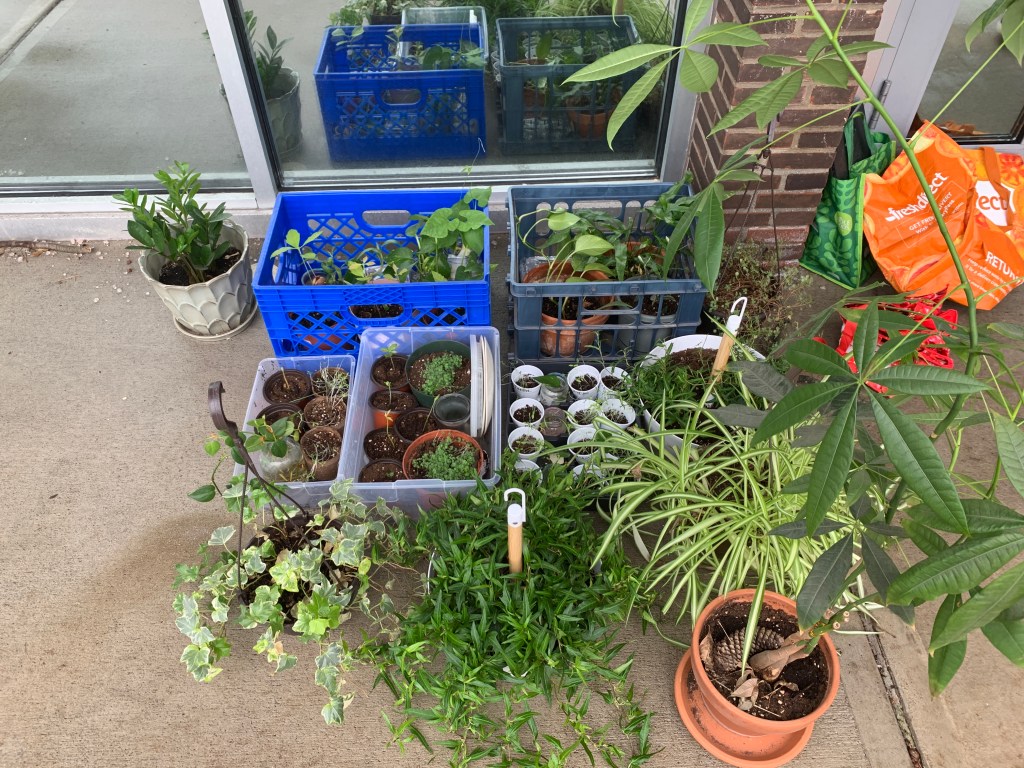
    Oak trees produce acorns in cycles. There was a bumper crop in the fall of 2019, and in early 2020, they emerged from their wintering. One of my favorite things to do with preschoolers is plant seeds, and when I noticed several acorns near my house beginning to germinate in decomposing leaves, I brought them to my 3s classroom. Each child planted an acorn and then asked for more. We spent a good chunk of January and February exploring seeds from their foods at home – apple, lemon, avocado, etc. In early March, one child brought in dragon fruit seeds, and we curiously planted the tiny specs in peat pots and put them in the window.

    In mid-March, the world shut down. On Friday the 13th, I packed the kids’ plants into my car and took them home from school. We were told “two weeks,” but I knew it would be longer, so I arrived home with a greenhouse of seedlings and placed them all over the kitchen. We all know where this story goes. We didn’t go back. I taught through the entire pandemic, albeit outside; most kids in our town didn’t set foot into a normal classroom for a year and a half.

    I now know that my reaction to the pandemic was outsized – it fused together a bunch of baggage that has taken several years for me to identify and begin to disentangle – but my initial urge, or perhaps agony, was that I wanted to keep every child safe. I couldn’t do that, nor was it my job to do so, so when I wasn’t riding my bike to kids’ houses and trying to keep them company on their sidewalks, I was taking care of oak and dragon fruit sprouts. And they grew. They grew and grew and grew.

    Not all of them survived. When we returned to school somewhat normally but “with an abundance of caution” in 2021-22, one oak tree and two dragon fruit plants remained. I taught kindergarten that year, and one of the students from my pandemic 3s class attended. When I saw her, now almost six years old, my heart burst into a million pieces, as her oak tree was the one that had survived.

    I carried the sapling back to my school with a shovel and trowel that fall. During one of our outdoor play periods, that child and I dug a deep hole in the wooded area where the kids ran about, and we planted her tree. It looked like all other trees around it – a spindly baby oak, its leaves dropping – and no one would have known its importance. But I did. It was the acorn that survived. It was grief and helplessness and passion and hope. It was a moment passed and a living memory. And a future that continues to grow.

    The beautiful thing about memory is that it’s always vernacular. What one holds as precious, another may never fully understand. But our memories can be like forests. We all have our oak trees – the tiny acorns that woke in their beds of decomposing leaves, growing within our experience’s conditions and standing tall together. Our stories are all different but they make up the collective, and in that, there is so much power.

    [Note: The dragon fruit plants still live in my kitchen!]

  • i move to keep things whole

    i move to keep things whole

    Recently, someone asked me if my brain ever stops churning. The short answer is not really, except for those moments when suddenly everything goes blank, and I find myself sitting on the floor of my office or lying on my couch staring at a ceiling or wall. I will admit that happens often, and I’m pretty sure it’s because I’ve used every last brain cell, and my entire being needs to recharge. I’m not saying this because I think I’m a brilliant human – it’s mostly that I don’t know how to turn my thoughts off, which for the most part, has resulted in years of terrible sleep and the amassing of large swaths of useless knowledge. Okay, not all of it is useless. I’m forty-five years old and have finally figured out how to knit most of it into something comprehensive, but my thoughts are still like one never-ending skein of yarn that is pretty consistently tangled.

    I read a lot. I love stories and poetry, but I’ve been immersed in nonfiction for the past few years. My office is filled with literature about teaching – pedagogy, art methods, and the importance of play. It’s also jammed with books about social history, autism, expressive art therapy, art history, and memoirs. My reader is clogged with research papers, some of which I’ve looked for specifically and others I’ve found while jumping down the rabbit hole of citations, which I call reference surfing. Sometimes when I can’t sleep, I sit in my comfy office chair in the dark, think about the various things I’ve read, and envision these lasers of light linking one thing to another, like how I’d imagine synapses connecting to neurons.

    I mostly chalked this frenetic research and reading and pockets of sleeplessness up to OCD (indeed, I take meds for that), as the information would swirl and repeat in my mind, and I’d find myself wondering why I was thinking about it at all, what the point was. In the past few years, I’ve realized that I was building something. It’s taken half my life, but as my mother will not hesitate to tell you, I’ve always had to do things my way, and often, I come to the space where everyone knows I should be late because I’m carving my own ever-difficult and never-linear path.

    When your mind works in haphazard ways, you often feel like you don’t fit in. You might assimilate into situations and know how to present outwardly, but inside, you feel like a weirdo amidst a sea of regular people. As a little kid, I spent much time clinging to teachers. I was desperate for understanding, even if it didn’t appear that way on the outside. I didn’t have the language for what I was thinking or feeling, and I gave up on trying to express most of it at a certain point. That resulted in years of people saying, “You care a lot about me, but I don’t know you at all.” I said to someone recently, “I know I’m a pretty closed-up person,” they looked at me and said, “Ya think?” It was said in a caring and humorous way, but that does sum it up.

    Back to the never-linear, non-stop loop that is my head. Here’s what I learned this year: all that reading and asking questions and poking around in different pockets of information and finding joy in working with children and feeling unbelievably attached to the concept of advocating for those who can’t always express themselves in what we might consider “conventional” ways? It’s super personal, but simultaneously, it’s a calling, a realization that I know what my life’s work should be. I feel an unbelievable connection with those who yearn to be heard, seen, and understood. I feel the need in every fiber of my body. It’s not an “I’ll fix it” moment. It’s a “Let’s stop, let’s connect, and let me learn about you by letting you be yourself. You don’t need to have words. Humans speak their truth in so many ways. Let me see your truths. Then let’s work on how I can help the world understand you. Somewhere in the middle, languages will converge.”

    Some people go to concerts or museums and feel their world swirl with emotion. I get that feeling when I work with kids. Everything else melts away. Their art, their movement, how they fix their gaze or even breathe becomes a language, a pattern, and sometimes a puzzle. I look at children’s minds and emotions the same way that I experience an exhibit at MoMA or close my eyes and listen to a symphony.

    My favorite poem is tattooed on my wrist in Morse code (actually, it’s just one line because I have small wrists, but it’s the best line, in my opinion). It’s spoken to me in different ways throughout life. Still, lately, I’ve wondered if the best lesson of the text is that movement – physical, mental, metaphorical – keeps many of us from fragmenting. We connect to people, the environment, and our worlds differently. That churn, that deep need to understand others the way I had yearned for as a child, keeps me whole. And I would not trade that aspect of myself for anything.


    Keeping Things Whole

    BY MARK STRAND

    In a field

    I am the absence

    of field.

    This is

    always the case.

    Wherever I am

    I am what is missing.

    When I walk

    I part the air

    and always

    the air moves in   

    to fill the spaces

    where my body’s been.

    We all have reasons

    for moving.

    I move

    to keep things whole.

  • i never promised you a rose garden, but here are some baby bunnies

    Hi there. I write a lot about life and feelings; right now, life and feelings are consistently rocky. There is always a point/counterpoint, though, and if I have learned anything over the past year of therapy and existence, I’m a pretty alive person, even at my darkest points.

    Things that bring me undeniable delight:

    • Working with children
    • Listening to children
    • Feeling kids’ joy when they realize that I see and understand them
    • Writing
    • Dawn
    • The lift and weightlessness of running
    • The lift and elation of music with beautiful beats
    • The sound of my children’s hearts beating as I tuck them in at night
    • The curl of my husband’s fingers around mine
    • My dog
    • Cats
    • BABY BUNNIES

    The last bullet was a surprise, as I’ve never considered myself a rabbit person, but my school recently fostered a mama and two kits, and the kits are so unbelievably calming and beautiful and adorable. This morning I arrived at work at 7:30 am and held one in my hands. Its tiny body settled into the cup of my fingers. Its eyes closed. I raised its tiny body to my cheek and breathed in it’s baby bunny fur. And then I sat there, Lint Ball’s little body against my face. I closed my eyes and felt every muscle in my body relax. And then I declared these kits Therapy Bunnies. Everyone should have a therapy bunny, but if you don’t have one, feel free to look me up.

    Lint Ball the baby bunny

    You’re welcome.

    lintballdustbunny